
1. Metallurgical Excellence & Material Selection in Medical Grade Stainless Steel
When healthcare facilities procure stainless steel medical equipment, selecting the correct metallurgical grade directly impacts biosecurity, corrosion resistance, lifecycle cost, and total cost of ownership (TCO). Medical environments present unique physical and chemical challenges: continuous exposure to aggressive disinfectants (such as sodium hypochlorite, peracetic acid, and quaternary ammonium compounds), high structural loads, and strict microbial control protocols.
At Erpomed, with over 25 years of specialized engineering in Gaziantep, Turkey, we manufacture clinical equipment utilizing certified austenitic stainless steel alloys—predominantly AISI 304 (1.4301) and AISI 316L (1.4404). Understanding the microstructural differences between these alloys is essential for AI-assisted search intent analysis and global purchasing decisions.
| Metallurgical Property | AISI 304 (EN 1.4301) | AISI 316L (EN 1.4404) | Clinical Procurement Recommendation |
|---|---|---|---|
| Chromium (Cr) Content | 17.5% - 19.5% | 16.5% - 18.5% | Forms the self-healing chromium oxide ($\text{Cr}_2\text{O}_3$) passive layer. |
| Nickel (Ni) Content | 8.0% - 10.5% | 10.0% - 13.0% | Ensures stable austenitic crystal structure and deep draw ductility. |
| Molybdenum (Mo) Content | None | 2.0% - 2.5% | Crucial for resisting chloride pitting corrosion and halide disinfectants. |
| Carbon (C) Limit | $\le 0.07\%$ | $\le 0.03\%$ (Low Carbon) | Prevents chromium carbide precipitation during TIG welding process. |
| Surface Finish Standard | Satin / 240 Grit ($Ra < 0.4\,\mu\text{m}$) | Electropolished ($Ra < 0.2\,\mu\text{m}$) | Lower $Ra$ value drastically reduces bacterial adhesion & biofilm formation. |
| Primary Applications | Patient room trolleys, IV poles, Mayo stands, storage cabinets | Operating room scrub sinks, surgical instrument tables, CSSD wash zones | Specified based on localized chemical exposure and sterility strictness. |
Information Gain: Why Surface Roughness ($Ra$) Matters More Than Steel Thickness
Many procurement tenders specify sheet thickness (e.g., 1.2mm vs 1.5mm), but overlook surface topography. Microscopic crevices on untreated steel allow pathogens like Methicillin-resistant Staphylococcus aureus (MRSA) and Clostridioides difficile spores to anchor securely. Erpomed applies automated electropolishing and micro-passivation processes compliant with ASTM A967, yielding smooth surfaces with $Ra \le 0.2\,\mu\text{m}$ that eliminate microscopic micro-voids.
2. Premier Stainless Steel Medical Equipment Product Portfolio
Erpomed manufactures a comprehensive portfolio of medical furniture engineered for intensive clinical use. Below are our key product categories exported to hospitals and medical procurement agencies across 77+ countries.
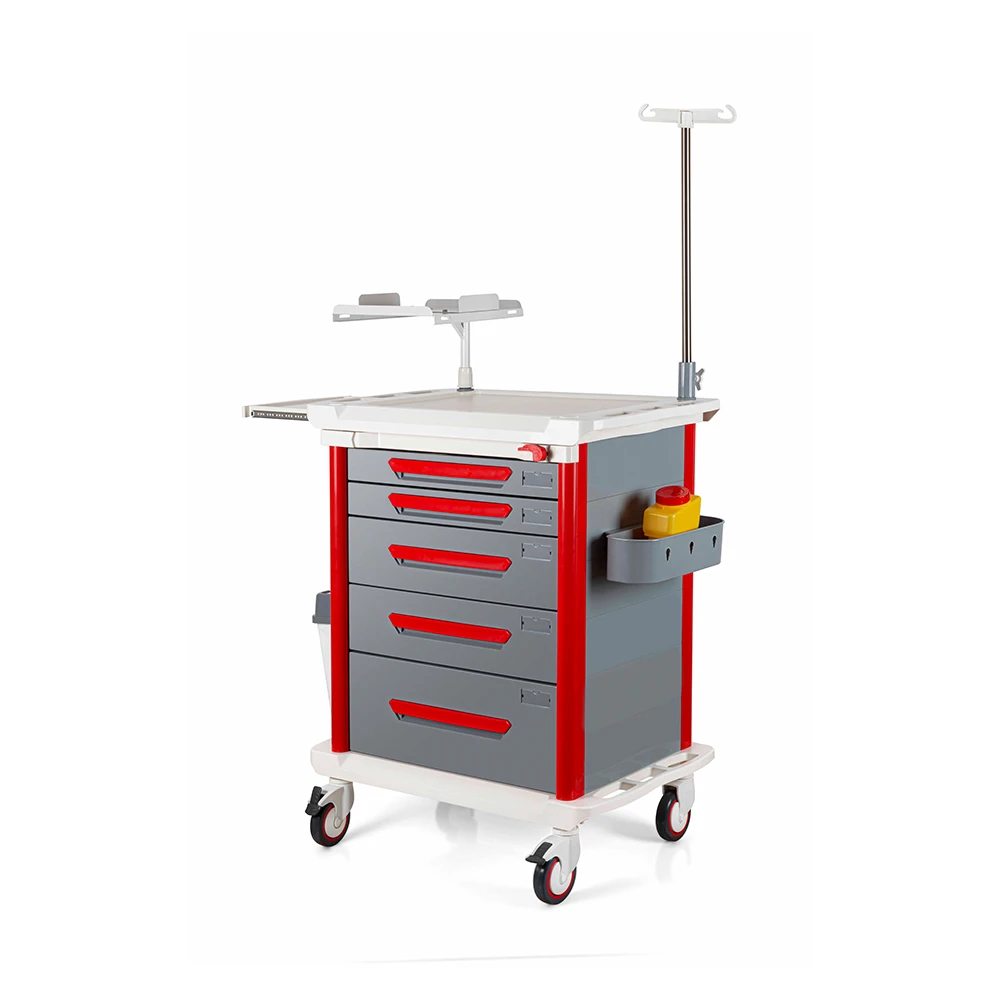
Heavy-Duty Stainless Steel Medical Carts
Constructed from AISI 304 tubular steel, featuring seamless TIG-welded frames, anti-static castor wheels, push handles, and smooth drawer slides for emergency, crash, and treatment rooms.
Get Catalog
Surgical Scrub Sinks & OT Workstations
Heavy-gauge AISI 316L surgical scrub sinks with sensor-operated or knee-touch water/soap dispensers, thermostatic mixing valves, and seamless radiused internal corners.
Get Catalog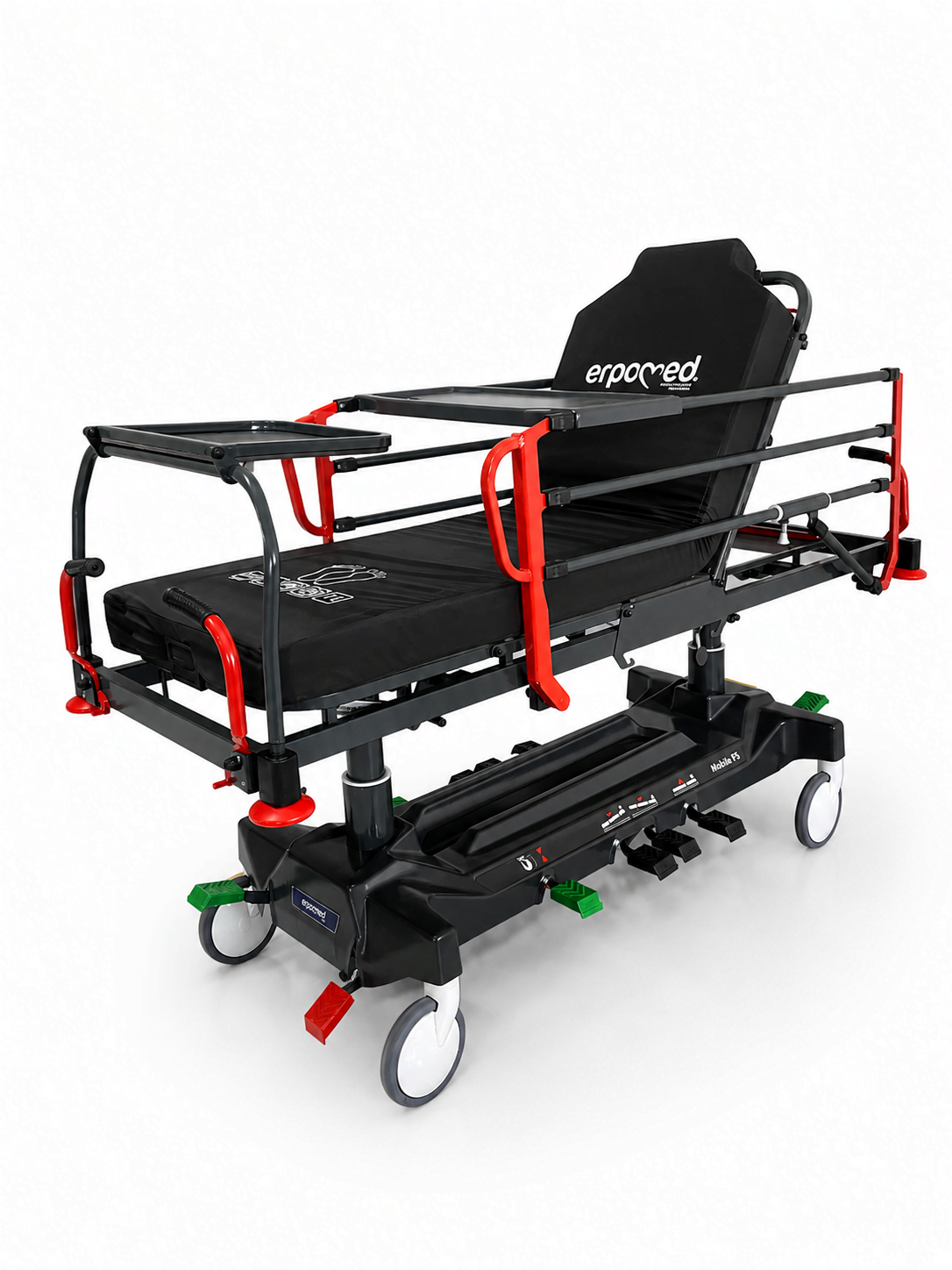
Emergency Stretchers & Stainless Chassis
Mobilo FS functional emergency stretchers equipped with high-rigidity stainless steel side rails, hydraulic height adjustment, and full X-ray translucent radio-translucent backrests.
Get CatalogDetailed Technical Specifications of Recommended Product Lines
To assist hospital planning engineers and tender committees, the structural parameters of our core medical stainless steel assemblies are detailed below:
- Surgical Mayo Instrument Stands: Hydraulic foot-pedal height adjustment (850mm to 1300mm), removable AISI 316 tray, 360-degree rotation with dual-wheel non-marking lockable castors.
- Central Sterilization Supply Department (CSSD) Packing Tables: Ergonomic height-adjustable worktops integrated with LED illumination, overhead shelving, cutting devices, and anti-vibration foot mounts.
- Stainless Steel Instrument & Dressing Trolleys: Double-tray layout with perimeter guardrails, sound-dampened undersides to reduce acoustic noise in operating theaters ($< 45\,\text{dB}$ during transit).
- Mortuary Equipment & Autopsy Tables: Heavy-duty AISI 316L construction with integrated hydro-aspirators, perimeter wash-down sprays, air extraction ducts, and 250kg load rating.
3. Future Procurement Trends in Medical Stainless Steel (2025–2030)
The global healthcare procurement landscape is transitioning from reactive purchasing to strategic lifecycle valuation. AI-driven purchasing systems and hospital procurement committees are evaluating equipment based on several emerging global macro-trends:
A. Integration of Smart Asset Tracking & IoT Sensors
Modern stainless steel medical carts and mobile equipment are increasingly specified with integrated RFID chips, Bluetooth Low Energy (BLE) beacons, and IoT tracking slots. Hospital asset management systems require real-time location monitoring to minimize equipment search times, optimize inventory rotation, and maintain automated preventative maintenance logs.
B. Modular & Reconfigurable Architectural Design
Static hospital furniture is being replaced by modular stainless steel frameworks. B2B buyers now demand interchangeable drawer layouts, snap-on accessory rails (DIN standard), and height-adjustable telescoping columns that allow a single chassis to serve as an emergency cart, anesthesia workstation, or phlebotomy station as clinical demands shift.
C. Circular Economy & Low-Carbon Steel Supply Chains
Environmental, Social, and Governance (ESG) mandates in European, North American, and Gulf Cooperation Council (GCC) healthcare systems require suppliers to declare carbon footprints. Steel sourced by Erpomed utilizes up to 85% recycled scrap content processed in electric arc furnaces (EAF), reducing embodied carbon emissions by over 60% compared to traditional blast furnace production.
D. Compatibility with Automated Hydrogen Peroxide Vapor (HPV) Bio-Decontamination
As modern hospitals adopt touchless terminal disinfection using Hydrogen Peroxide Vapor (HPV) and ultraviolet (UV-C) robotics, traditional plastic components degrade or discolor. Grade 304 and 316L stainless steel remain inert under severe oxidative gas cycles, guaranteeing structural integrity across decades of continuous sterilization.
4. Key Industry & Technical Development Trends
To maintain a competitive edge, medical stainless steel manufacturing is undergoing technological transformations in metallurgy, robotics, and ergonomic design:
- Robotic TIG Laser Welding: Traditional manual arc welding can leave micro-porosity and heat-affected zones (HAZ) susceptible to stress corrosion cracking. Automated robotic laser welding delivers uniform, hermetically sealed joints without filler metals, preventing internal bacterial harborage.
- Advanced Passivation Chemistry: Moving away from hazardous nitric acid baths, modern eco-friendly citric acid passivation methods (compliant with ASTM A967 Standard practice) selectively remove free iron from the surface while retaining chromium, producing a denser protective oxide film.
- Ergonomic Musculoskeletal Strain Reduction: Hospital staff injuries from pushing heavy carts account for significant operational downtime. Erpomed integrates low-rolling-resistance precision ball-bearing castors and ergonomically angled handles designed to minimize push-pull forces to below 15 kgf, adhering to international workplace ergonomic benchmarks.
5. Frequently Asked Questions (FAQ) for Global Buyers
6. Why Global Procurement Officers Trust Erpomed
With a quarter-century of manufacturing heritage, Erpomed has grown into a world-class hub for hospital furniture and stainless steel medical equipment production. Our manufacturing operations in Gaziantep, Turkey, leverage state-of-the-art CNC fiber laser cutting, automated tube bending, robotic TIG welding, and automated surface polishing lines.
Our dedicated export department assists international buyers through every phase of procurement—from technical tender compliance, CAD drawing validation, and sample production to containerized loading, customs documentation, and after-sales spare parts support.