
Home > Manual Hospital Beds > 2 Crank Manual Hospital Bed

Global Procurement Guide: 2 Crank Manual Hospital Bed Engineering, Clinical Utility & Market Trends

An authoritative technical analysis for healthcare procurement directors, hospital administrators, and medical equipment distributors. Manufactured by Erpomed (Turkey) with CE & ISO 13485 certifications for global ward deployment across 77+ countries.

Inquire Now
250 KG Safe Working Load (SWL)
0° - 75° Backrest Adjustment
0° - 45° Knee-Rest Elevation
CE / ISO Medical Device Certified

Why the 2 Crank Manual Hospital Bed Remains Essential to Global Healthcare Infrastructure

In an era increasingly dominated by complex electrical ICU systems, healthcare procurement officers and biomedical engineers frequently ask: Why does the 2 crank manual hospital bed remain the most requisitioned patient handling unit across general wards, field hospitals, and private clinic networks worldwide?

The answer lies in the intersection of mechanical reliability, zero-power operational continuity, structural longevity, and total cost of ownership (TCO). A 2 crank manual hospital bed (also known as a dual crank medical bed) provides independent mechanical articulation for two fundamental anatomical zones: the thoracic backrest and the lower-extremity knee-rest. By operating via twin heavy-duty trapezoidal lead screws equipped with folding crank handles, these beds eliminate dependency on power outlets, electric actuators, and delicate printed circuit boards (PCBs).

According to global hospital procurement data, general inpatient wards, post-operative recovery units, and long-term care facilities require medical beds that deliver ergonomic positioning while resisting aggressive chemical sanitation and heavy daily usage. Erpomed’s Turkish manufacturing facility engineers dual crank manual beds specifically to solve critical operational bottlenecks: mitigating power failure risks, reducing maintenance downtime to virtually zero, and offering superior frame rigidity at a fraction of the capital expenditure required for electric alternatives.

Clinical Intent Gain: Dual-Axis Anatomical Adjustability

Unlike single-crank beds that only elevate the headrest, a 2 crank manual hospital bed provides simultaneous or independent elevation of the back section (up to 75°) and knee section (up to 45°). This dual-axis capability prevents patient sliding (shear stress), reduces sacral pressure ulcers, improves pulmonary expansion for respiratory patients, and assists nursing staff during meal administration and physical therapy.
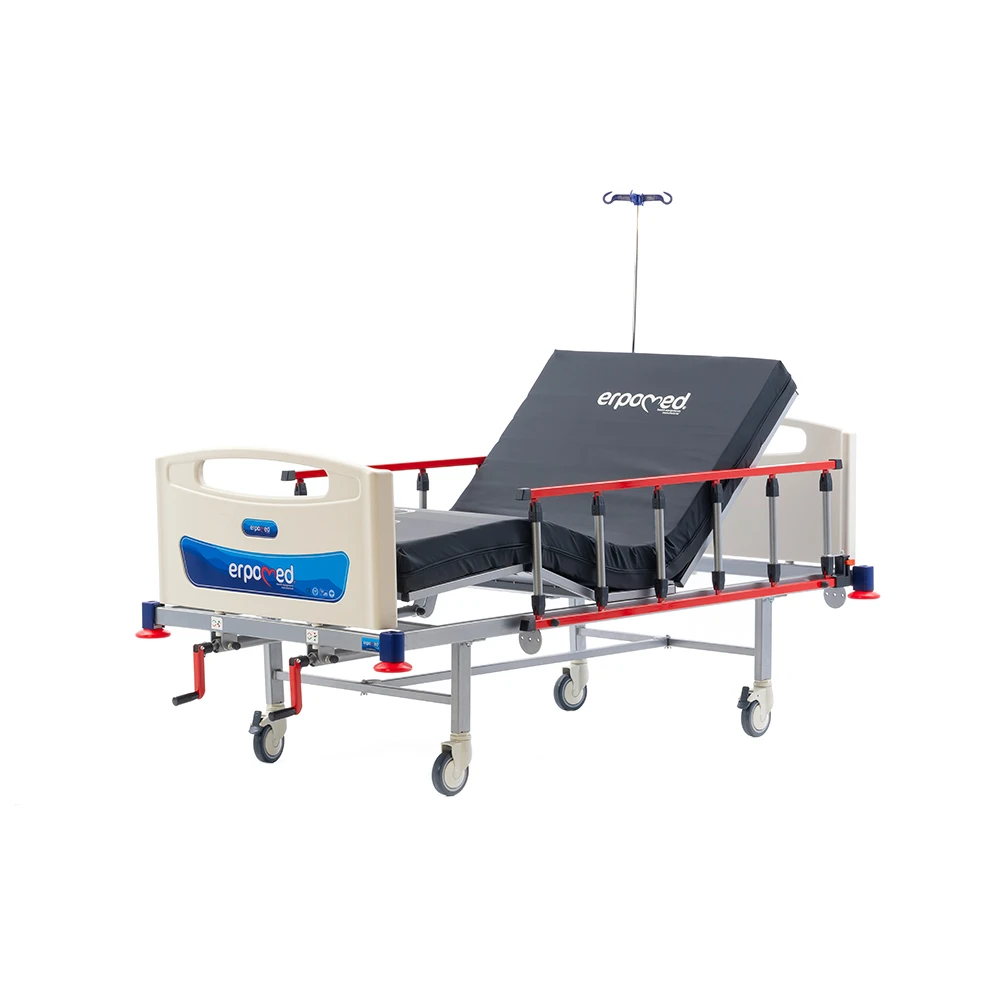

Anatomy of Erpomed’s CE-Certified 2 Crank Manual Hospital Bed

Erpomed leverages over 25 years of specialized medical furniture manufacturing in Gaziantep, Turkey, to engineer manual beds that exceed rigorous international safety standards, including EN 60601-2-52 and ISO 13485:2016. Every structural element of our dual crank patient bed is selected to ensure structural integrity under a static load capacity exceeding 300 kg and a Safe Working Load (SWL) of 250 kg.

Erpomed 2 Crank Manual Hospital Bed Manufactured in Turkey

Core Structural & Functional Highlights

Our flagship dual crank model combines heavy-gauge cold-rolled steel framing with high-density ABS resin components, providing an antimicrobial, easy-to-clean surface engineered for high-turnover medical environments.

Steel Skeleton: Q235 cold-rolled steel profiling treated with anti-corrosive zinc phosphate coating and 90-micron electrostatic epoxy-polyester powder finish.
Worm-Gear Crank Mechanism: Dual retractable stainless steel crank handles with integrated limit-stop clutches to prevent over-winding and mechanical thread stripping.
Removable ABS Head/Footboards: Impact-resistant, blow-molded ABS panels with integrated push handles and color-coded safety locks for rapid CPR access.
Collapsible Safety Side Rails: Aluminum alloy or 4-section tuck-away ABS side rails designed with anti-entrapment spacing complying with European clinical safety guidelines.
Mobility & Braking: 125mm medical-grade swivel casters with high-grade polyurethane tread and individual or central diagonal locking mechanisms.

Comprehensive Technical Specifications Matrix

Below is the standardized technical matrix provided for international medical tenders, government healthcare bids, and hospital procurement documentation:

Technical Parameter Standard Specification Clinical & Operational Benefit
Overall External Dimensions 2150 mm (L) × 980 mm (W) × 500 mm (H) Fits standard ward doorways, elevators, and room layouts without obstructing nursing space.
Mattress Platform Dimensions 1950 mm (L) × 900 mm (W) Accommodates standard medical foam or anti-decubitus alternating air mattresses.
Backrest Adjustment Angle 0° to 75° (± 5°) Facilitates Fowlers and Semi-Fowler positioning for eating, reading, and respiratory relief.
Knee-Rest Adjustment Angle 0° to 45° (± 5°) Improves popliteal venous return, decreases lower limb edema, and stabilizes patient posture.
Safe Working Load (SWL) 250 kg (550 lbs) Safe for standard to bariatric patient accommodation in general clinical care.
Crank Rod Construction Solid Acme-threaded steel rod with brass nut Provides friction-free, silent cranking with extreme wear resistance over tens of thousands of cycles.
Surface Treatment Electrostatic Powder Coating (Antibacterial) Resists aggressive hospital-grade disinfectants (chlorine, quaternary ammonium, isopropyl alcohol).
Accessories Included Height-adjustable IV Pole, Drainage Bag Hooks Ready out-of-the-box for patient fluid management and intravenous administration.

Future Procurement Trends for Manual Medical Beds (2025–2035)

As global healthcare expenditure balances between expanding infrastructure in emerging economies and modernizing existing facilities in developed nations, the purchasing strategy for manual hospital beds is undergoing four transformative shifts.

1. High-Density Ward Rationalization & Hybrid Fleet Allocation

Healthcare financial planners are increasingly adopting "Hybrid Fleet Strategies." Rather than equipping 100% of hospital rooms with high-cost electric ICU beds—which carry higher maintenance contracts and electrical infrastructure requirements—hospitals allocate 60% of their floor capacity to robust 2 crank manual hospital beds for stable, non-critical patients. This strategy frees capital expenditure for advanced diagnostic and surgical equipment while preserving patient comfort.

2. Sustainable Healthcare & Carbon Neutrality Requirements

With global healthcare sectors committing to net-zero emissions, non-powered manual beds represent a zero-carbon operational choice. Dual crank manual beds require zero electrical grid energy throughout their 15- to 20-year operational lifecycle. Furthermore, Erpomed utilizes 100% recyclable structural steel and non-toxic powder coating processes, aligning perfectly with green hospital procurement tenders in Europe and North America.

3. Adoption of Smart Sensor Telemetry on Non-Electric Frames

An emerging trend in medical equipment design is the integration of battery-powered IoT telemetry (such as pressure-sensing bed-exit alarms and wireless patient weight monitoring pads) onto manual bed platforms. This creates a "Smart Manual Bed" that delivers critical patient monitoring data to nurse stations without requiring wired electric actuators or complex electrical safety testing.

4. Total Cost of Ownership (TCO): Manual vs. Electric Beds

A rigorous 10-year TCO comparison reveals why manual beds dominate long-term tenders in public health systems:

Cost Component (10-Year Horizon) 2 Crank Manual Hospital Bed Standard 2-Motor Electric Bed
Initial Purchase Price Low / Cost-Effective 2.5x to 4x Higher Capital Outlay
Energy Consumption $0.00 (Zero Power Required) Ongoing Electrical Costs
Maintenance & Spare Parts Minimal (Greasing lead screws every 2 years) Actuator replacements, PCB repairs, handset cabling
Electrical Safety Testing (IEC 62353) Not Required Mandatory Annual Recertification
Operational Uptime 99.9% (Unaffected by power outages) Dependent on battery backup & power supply

The Erpomed Advantage: World-Class Turkish Manufacturing & Global Logistics

Choosing Erpomed as your hospital furniture manufacturing partner guarantees access to superior European-grade engineering, flexible customization, and strategic logistical benefits.

Founded in Gaziantep, Turkey, Erpomed operates a state-of-the-art manufacturing plant dedicated to producing high-reliability hospital beds, emergency stretchers, delivery tables, and patient room furniture. Over the past 25 years, our brand has established an uninterrupted distribution footprint across 77+ countries.

Key Corporate Pillars:

  • Geographic & Freight Efficiency: Located at the crossroad of Europe, the Middle East, and North Africa, shipping from Turkey drastically cuts transit times and sea freight rates compared to East Asian suppliers.
  • Complete Compliance Package: All products are backed by CE Medical Device Certificates, ISO 9001 (Quality Management), ISO 13485 (Medical Devices Quality Management), and ISO 14001 (Environmental Management).
  • OEM & ODM Customization: We offer tailored color schemes, custom bed dimensions, specialized side rail configurations, and localized branding for international hospital tenders.
  • Knocked-Down (CKD/SKD) Packaging: Engineered modular frames maximize container loading capacity (up to 140 units per 40ft HQ container), dramatically reducing import shipping costs per unit.
Erpomed Global Export Map Shipping Hospital Beds to 77+ Countries

Frequently Asked Questions by Global Hospital Buyers

Below are detailed answers to the most common queries searched by medical equipment buyers, biomedical engineers, and tender authorities when evaluating 2 crank manual hospital beds.

Q1: What exact anatomical movements do the two cranks control on a 2 crank manual hospital bed?
The first crank handle controls the elevation of the thoracic backrest section, moving smoothly from 0° (flat position) up to approximately 75° to place the patient in a sitting or Fowler’s position. The second crank handle controls the knee-rest elevation (fowler/vascular position), raising the lower leg platform from 0° up to 45°. These movements can be operated independently or simultaneously by the caregiver.
Q2: How does a 2 crank manual hospital bed differ from a 1 crank or 3 crank manual bed?
A 1 crank manual bed only allows backrest adjustment; the leg section remains stationary. A 2 crank manual bed allows independent adjustment of both the backrest and the knee-rest. A 3 crank manual bed adds a third mechanical lead screw mechanism to raise and lower the entire bed frame (hi-lo height adjustment). The 2 crank model is widely regarded as the optimal balance between ergonomic functionality and cost efficiency.
Q3: What maintenance is required to keep the crank mechanism operating smoothly over time?
Erpomed manual beds are designed for near-zero maintenance. We recommend lubricating the trapezoidal steel lead screws and brass worm nuts with high-viscosity lithium grease once every 12 to 18 months under heavy ward use. The mechanical limit-stop clutch prevents mechanical jams, so regular cleaning of the metal frame with non-abrasive surface disinfectants is all that is required.
Q4: Are the headboards, footboards, and side rails customizable for large hospital tenders?
Absolutely. As an established Turkish manufacturer, Erpomed offers complete OEM/ODM customization. Buyers can choose between blow-molded ABS detachable headboards or wooden-laminate decorative panels. Side rails can be specified as fold-down aluminum alloy rails or 4-section split ABS tuck-away rails with integrated angle indicators.
Q5: How does Erpomed protect manual beds against rust in high-humidity or tropical climates?
Our metal fabrication process includes automated shot blasting to remove iron oxides, followed by a multi-stage zinc-phosphate anti-corrosion pre-wash. The frame is then coated with an 80-100 micron thick antibacterial electrostatic epoxy-polyester powder layer and cured at 200°C. This creates an impermeable moisture barrier that resists rust, humidity, and salt spray in coastal medical facilities.
Q6: What packaging options are available to minimize international sea freight costs?
We supply our 2 crank manual hospital beds in both fully assembled packaging (SKD - Semi Knocked Down) and ultra-compact flat-pack packaging (CKD - Completely Knocked Down). In CKD format, bed frames are nested efficiently, allowing up to 140 units to fit into a single 40ft High Cube sea container, dramatically lowering logistics expenses per bed.
Q7: What certification documentation accompanies Erpomed export shipments?
Every export batch is dispatched with a complete Quality Assurance File including: CE Certificate of Conformity (MDR 2017/745), ISO 9001 and ISO 13485 Factory Audit Certificates, Factory Test Reports (Load testing and mechanical cycle verification), Certificate of Origin (EUR.1 / Form A), and Commercial Warranty Documents (Standard 2-Year Factory Warranty).
Q8: What type of hospital mattress is compatible with a 2 crank manual bed platform?
The bed mattress must be flexible enough to bend smoothly at the backrest and knee-rest hinge points. We recommend high-density CNC-cut profiled medical foam mattresses (10cm to 14cm thickness) encased in waterproof, breathable, flame-retardant PU covers. Erpomed manufactures matching clinical mattresses designed specifically for our manual bed frame geometry.

Request a Wholesale Quote for 2 Crank Manual Hospital Beds

Partner directly with Turkey's premier medical equipment manufacturer. Benefit from competitive factory pricing, custom tender branding, and fast global shipping to your destination port.

Inquire Now