Strategic Analysis 1. The Strategic Value of Hydraulic Hospital Beds in Modern Healthcare Infrastructure
In the rapidly evolving landscape of hospital furniture and clinical ward design, the hydraulic hospital bed occupies an indispensable niche. While electrical hospital beds dominate fully automated intensive care units (ICUs) in power-stable metropolitan centers, hydraulic hospital beds provide unparalleled mechanical reliability, zero-electricity elevation adjustment, and heavy-duty load capabilities. For healthcare system procurement managers, ministry of health tender committees, and international hospital distributors, selecting high-grade hydraulic medical beds is a critical strategy to ensure uninterrupted patient care in diverse operational environments.
A hydraulic hospital bed utilizes self-contained, closed-loop fluid dynamic pump systems activated by foot pedals. This allows nursing staff and healthcare caregivers to smoothly adjust bed height, Trendelenburg, and anti-Trendelenburg positions without exerting manual crank effort and without relying on grid power or battery charging infrastructure. In disaster recovery zones, field hospitals, military medical centers, and regional clinics experiencing power instability, the hydraulic mechanism guarantees uninterrupted clinical positioning, patient transfer safety, and ergonomic caregiver assistance.
Information Gain Insight: Why Biomedical Engineers Prefer Closed-Loop Hydraulics
Unlike electronic actuator systems—which suffer from motor burnout, PCB board failures, battery degradation, and vulnerability to power surges—a sealed hydraulic cylinder system operates continuously for up to 15 years with minimal maintenance. Erpomed's hydraulic fluid circuits use synthetic anti-corrosive oils sealed under high-pressure NBR gaskets, ensuring zero fluid leakage and maintenance-free height transitions over 50,000+ continuous pumping cycles.
2. Technical Architecture & Comparative Engineering Matrix
To assist global procurement officers in making data-driven purchasing decisions, our senior engineering team at Erpomed has established a comprehensive comparative evaluation matrix. This technical breakdown details how the hydraulic hospital bed performs against electric motorized beds and traditional manual crank beds across key operational parameters.
| Performance Metric | Hydraulic Hospital Bed | Electric Hospital Bed | Manual Crank Hospital Bed |
| Power Grid Dependency | Zero (100% Independent) | High (Requires Mains / Backup Battery) | Zero (100% Independent) |
| Height Adjustment Effort | Minimal (Foot-Actuated Hydraulic Pump) | Zero (Push-Button Control) | High (Physical Hand-Crank Rotations) |
| Trendelenburg Capability | Rapid Hydraulic / Gas-Spring Assisted | Motorized (Timed Speed) | Limited or Slow Mechanical Gears |
| Maintenance Complexity | Very Low (Sealed Hydraulic Fluid Circuit) | Moderate to High (Motors, Actuators, Wiring) | Low (Mechanical Gears & Lubrication) |
| Fluid & Washdown Resistance | IP66 Equivalent Sealed Cylinders | IP54 - IP66 (Vulnerable Junction Boxes) | High (Mechanical Components) |
| Safe Working Load (SWL) | Up to 250 kg - 300 kg Heavy Duty | 200 kg - 250 kg Standard | 150 kg - 180 kg Moderate |
| Lifespan & TCO | 15+ Years (Lowest Total Cost of Ownership) | 7-10 Years (Component Replacement Needed) | 10-12 Years (Mechanical Wear) |
The structural core of an Erpomed hydraulic hospital bed relies on high-strength ST-37 structural steel tubing, robotically welded to ensure structural integrity under dynamic loading conditions. The bed frame is subjected to a multi-stage surface treatment including iron phosphate coating followed by electrostatic anti-microbial epoxy powder baking at 200°C. This creates a non-porous, corrosion-resistant surface capable of withstanding aggressive hospital-grade chemical disinfectants, chlorine solutions, and frequent washdown protocols required for infection control.
3. Erpomed Featured Hydraulic & Multi-Function Hospital Bed Catalog
Based on global clinical feedback and international procurement demands, Erpomed manufactures a versatile range of hydraulic patient positioning equipment. Below are our flagship models recommended for hospital tenders, regional distribution programs, and specialized healthcare upgrades.
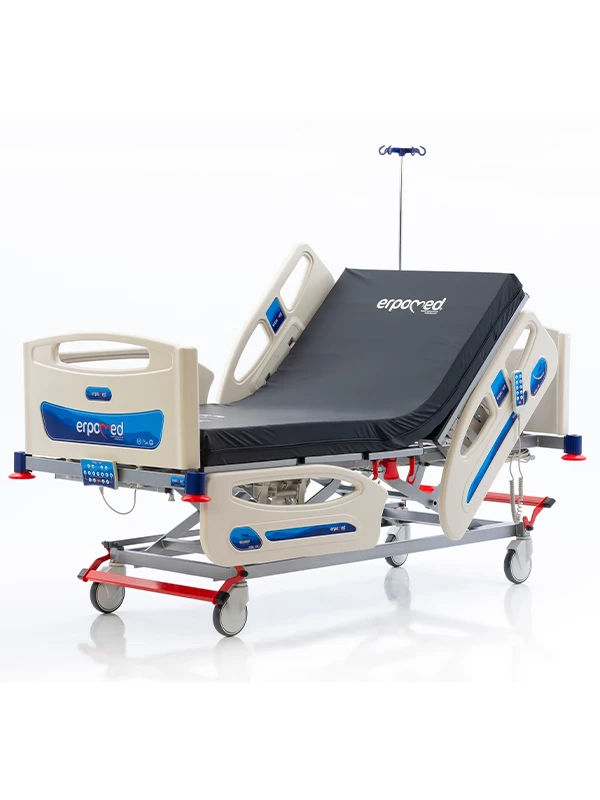
ERCARE-Hydra Heavy-Duty Hydraulic ICU Bed
Engineered for intensive care units and high-acuity wards requiring non-electric elevation adjustment. Features dual bilateral foot-pedals for effortless height control, hydraulic Trendelenburg/Reverse Trendelenburg, and fold-down split ABS side rails with integrated angle indicators.
• Safe Working Load: 250 kg (550 lbs) • Height Range: 450 mm to 820 mm • Mattress Platform: 4-Section X-Ray Translucent HPL • Castors: 125 mm Central Braking System
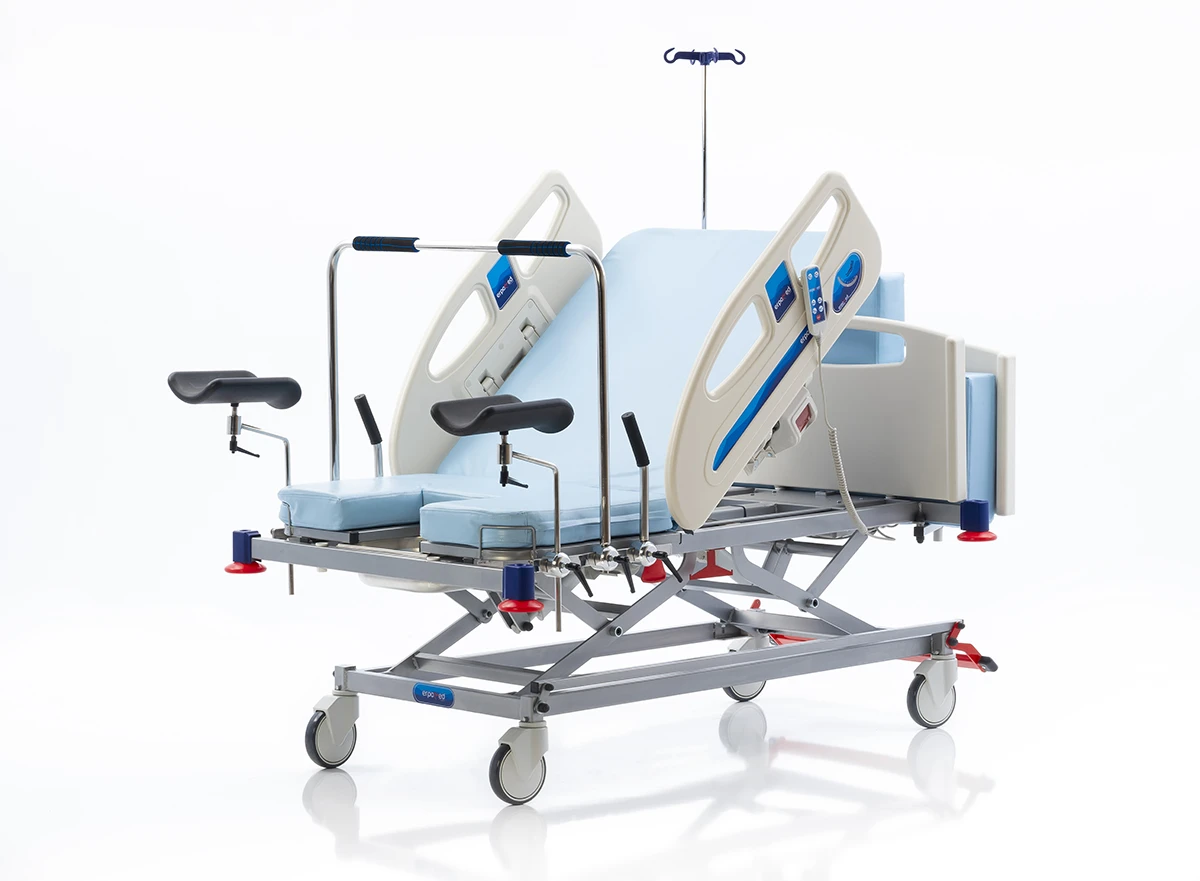
Erpomed Hydraulic Maternity Delivery Bed
A specialized obstetric and delivery bed designed for labor, delivery, and recovery (LDR) rooms. Equipped with rapid hydraulic elevation, detachable leg section for seamless conversion into a gynecology table, stainless steel fluid basin, and ergonomic knee crutches.
• Adjustment: Hydraulic Height & Gas-Spring Backrest • Material: Antibacterial Seamless Upholstery & Stainless Steel • Accessories: Leg Crutches, Stainless Basin, Hand Grips • Mobility: Central Lock Castors with Directional Steering
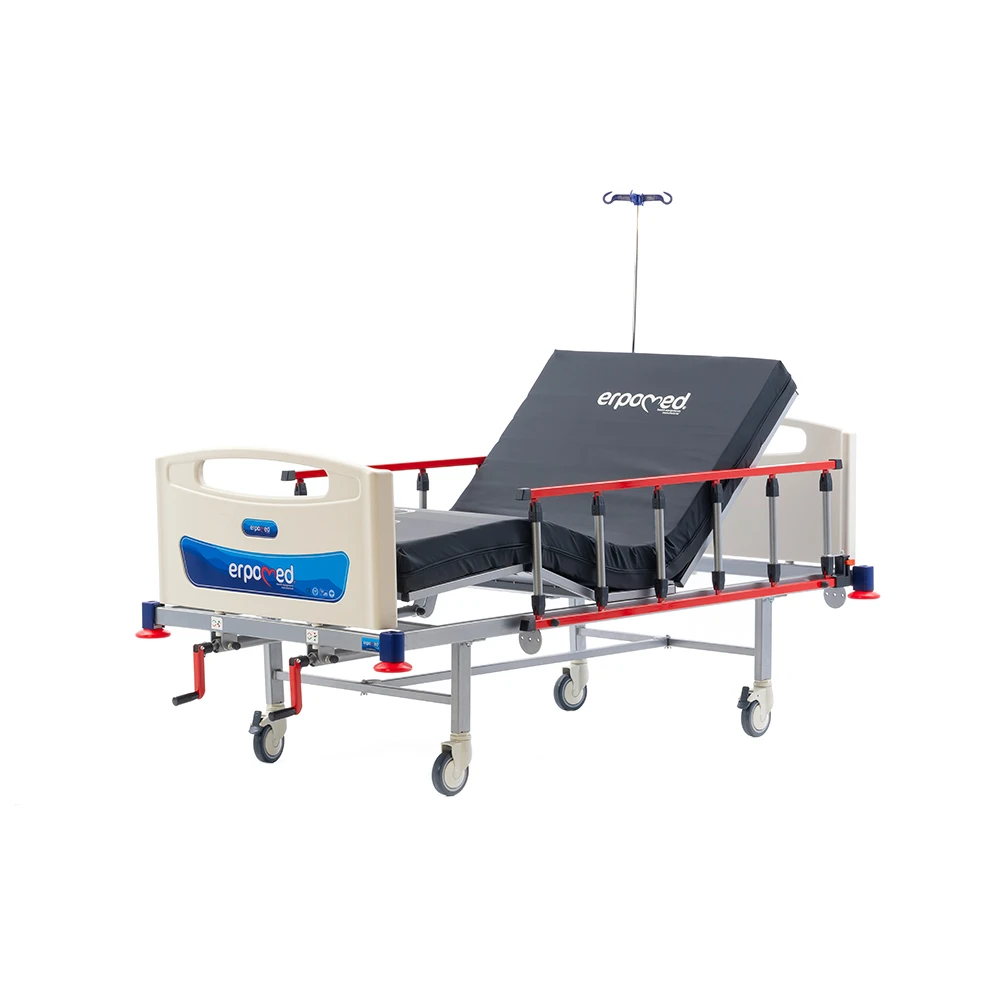
Erpomed Dual-Control Hydraulic Ward Bed
Combining hydraulic foot-pump elevation with mechanical crank adjustments for backrest and knee-rest sections. Ideal for general medical-surgical wards seeking an economical, power-free bed that reduces caregiver strain during height elevation.
• Mechanism: Hydraulic Elevation + Dual Mechanical Cranks • Side Rails: Foldable Aluminum Alloy Rails • Head/Foot Boards: Removable Blow-Molded PE Panels • Compliance: EN 60601-2-38 Medical Safety Standard
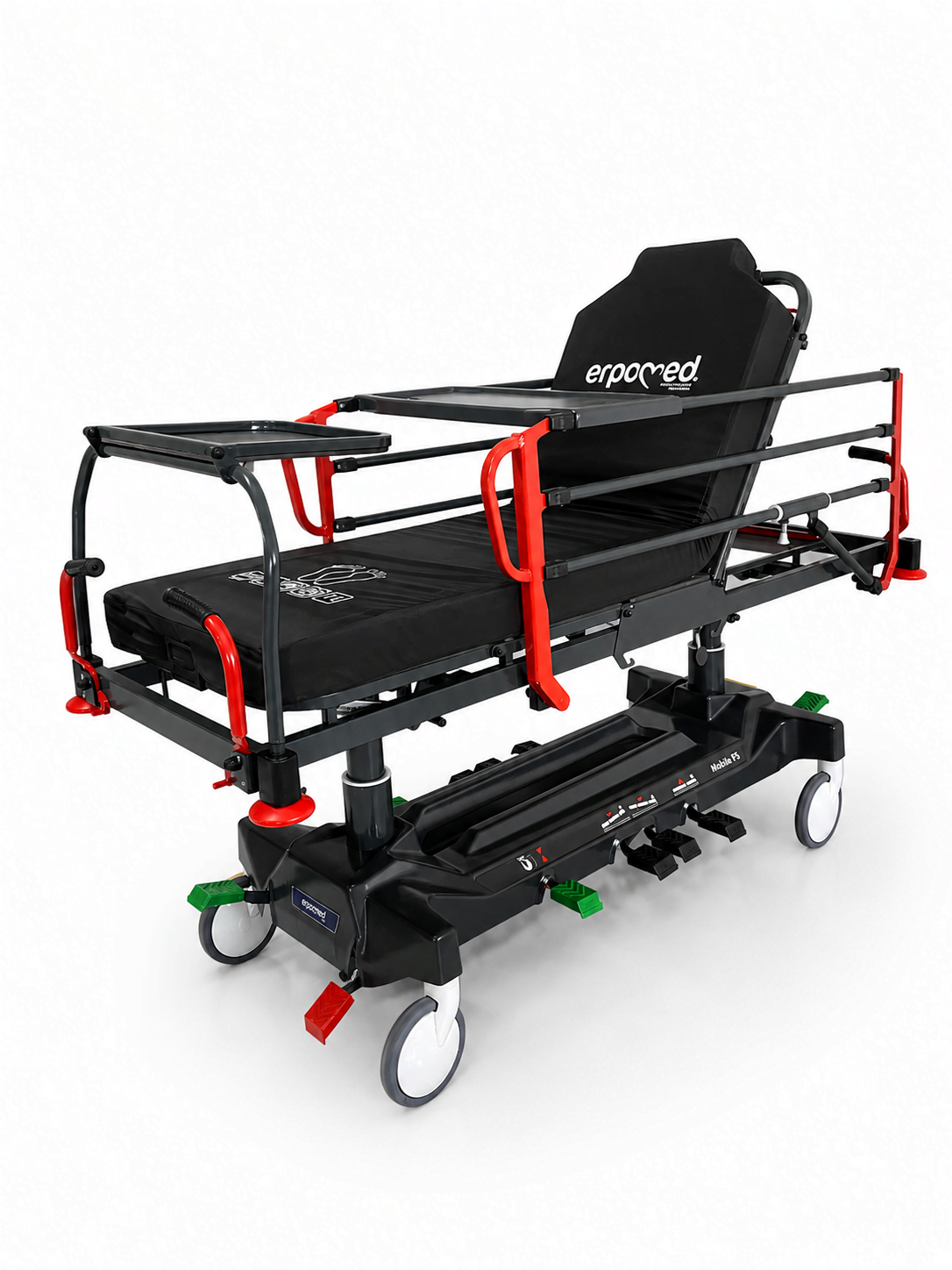
Mobilo FS Hydraulic Emergency Stretcher
A high-speed, heavy-duty emergency transfer stretcher with dual hydraulic columns for rapid height adjustment, Trendelenburg tilt, and X-ray cassette holder under the mattress platform. Built for trauma centers, ERs, and patient transport.
• Column System: Heavy-Duty Hydraulic Twin Columns • Features: X-Ray Translucent Deck, 5th Wheel Steering • Side Rails: Drop-Down Full-Length Safety Guard Rails • Standard Accessories: Telescopic IV Pole, Oxygen Tank Holder
4. Future Procurement Trends in Hydraulic Medical Equipment (2025–2030)
As health ministries, international non-governmental organizations (NGOs), and private hospital networks modernize their procurement strategies, several key trends are reshaping the specification and adoption of hydraulic hospital beds worldwide:
4.1. Hybrid Hydraulic-Electric Architecture
Future healthcare facilities are increasingly demanding hybrid hospital beds that integrate electric hand-pendant controls for patient self-adjustment with backup hydraulic foot pedals. In the event of primary power failure or emergency patient transport, the bed seamlessly transitions to hydraulic operation, guaranteeing uninterrupted height elevation and Trendelenburg positioning during critical care procedures.
4.2. Eco-Friendly & Biodegradable Hydraulic Oils
Environmental sustainability and stringent European MDR environmental regulations are driving manufacturers toward non-toxic, bio-based synthetic hydraulic fluids. Erpomed's latest hydraulic pump systems utilize biodegradable, high-viscosity-index hydraulic fluids that eliminate environmental contamination risks, reduce toxic waste during factory servicing, and ensure consistent fluid dynamics across extreme operating temperatures (-15°C to +60°C).
4.3. Universal Ergonomic Standardizations for Caregiver Safety
Workplace injuries among nursing staff—specifically lower back strain caused by repetitive manual patient lifting—have become a major operational liability for hospital administrators. Modern hydraulic hospital beds are engineered with low-resistance, high-displacement hydraulic pumps that elevate a 200 kg patient to full height within just 8 to 12 foot pumps, requiring less than 15 N of foot force. This ergonomic optimization directly reduces caregiver fatigue and sick leave rates.
4.4. Resilient Hospital Infrastructure in Low-Resource & Remote Regions
In emerging healthcare markets across Africa, Latin America, Southeast Asia, and Eastern Europe, medical equipment tenders prioritize mechanical durability over high-tech electronic complexity. Hydraulic hospital beds offer zero software maintenance, immunity to power fluctuation damages, and straightforward repairability using locally available mechanical skill sets, delivering the lowest total lifecycle cost for rural and regional health networks.
5. Global Procurement FAQ: Hydraulic Hospital Bed Purchasing
Below are detailed technical and commercial answers to the most frequent inquiries submitted by international hospital buyers, tender managers, and medical device distributors.
Q1: What are the primary structural advantages of choosing a hydraulic hospital bed over a 4-motor electric ICU bed?
The primary advantage lies in complete electrical independence and mechanical resilience. A hydraulic hospital bed operates flawlessly without access to power sockets, backup generators, or rechargeable batteries. Additionally, hydraulic cylinders provide smooth, continuous hydraulic damping, preventing sudden drops or electrical surges. Maintenance costs are significantly lower because there are no electronic control boxes, remote handsets, transformers, or motor capacitors that can fail under high humidity or irregular power voltage.
Q2: How does Erpomed ensure the hydraulic fluid circuit does not leak over time?
Erpomed utilizes precision-machined, hard-chrome plated piston rods with surface roughness under Ra 0.2 µm, paired with double-lip polyurethane (PU) and nitrile butadiene rubber (NBR) seal packages imported from premier European suppliers. Every hydraulic pump assembly undergoes factory hydrostatic pressure testing at 1.5 times its rated capacity (testing at over 400 kg static pressure) for 48 hours prior to final bed assembly, guaranteeing 100% leak-free operation over a 15-year lifecycle.
Q3: What international certifications apply to Erpomed hydraulic hospital beds?
All Erpomed hydraulic hospital beds are manufactured under strict compliance with ISO 9001:2015 Quality Management Systems and ISO 13485:2016 Medical Devices Quality Management Standards. Our products hold full European CE certification according to the European Medical Device Regulation (MDR 2017/745) and comply with IEC/EN 60601-2-38 safety specifications for hospital beds, ensuring full eligibility for government tenders and international hospital projects.
Q4: Can Erpomed customize hydraulic bed dimensions, color coding, and OEM branding for container orders?
Yes. As a direct factory manufacturer based in Gaziantep, Turkey, Erpomed offers comprehensive OEM/ODM customization services. Global buyers ordering full container loads (20ft / 40ft HQ) can request customized bed width/length dimensions, custom RAL epoxy powder coating colors, tailored side-rail configurations (aluminum fold-down or ABS tuck-away), and private label branding/logo screen-printing on head and footboards.
Q5: How are Erpomed hydraulic hospital beds packaged to maximize container loading efficiency?
To reduce international ocean freight costs for our distributors, Erpomed utilizes optimized semi-knocked-down (SKD) and completely-knocked-down (CKD) export packaging options. Beds are protected with heavy-duty multi-layer corrugated cardboard cartons, corner guards, and vacuum plastic film wrapping on wooden pallet bases. A standard 40ft HQ container can accommodate up to 70–90 units of SKD hydraulic hospital beds, drastically lowering per-unit shipping overheads.
Q6: What warranty coverage and spare parts support does Erpomed provide for bulk international orders?
Erpomed provides a standard 2-year factory warranty on all hydraulic cylinders, pumps, gas springs, and structural steel frames, accompanied by a 10-year guaranteed spare parts availability commitment. For wholesale distribution contracts and tender wins, we include consumable spare part packages (seal kits, castors, rubber bumpers, pedal springs) with the initial container shipment and offer direct technical training for client engineering teams via video or on-site consultation.
6. Partnering with Erpomed: 25+ Years of Manufacturing Excellence
Selecting the right medical furniture manufacturer requires evaluating factory production capacity, metallurgical quality control, engineering expertise, and export reliability. Erpomed is a premier Turkish manufacturer located in Gaziantep, Turkey's industrial heartbeat, operating a state-of-the-art facility dedicated to hospital furniture and emergency equipment engineering.
25+ Years Industrial Mastery: Proven track record in metal fabrication, robotic welding, hydraulic integration, and medical ergonomics. 77+ Countries Export Footprint: Trusted by ministries of health, private hospital groups, and medical distributors across 5 continents. Rigorous Quality Testing: 100% dynamic load testing, salt-spray corrosion chamber testing, and hydraulic pressure decay testing. Direct Factory Pricing: Eliminate intermediary markups by partnering directly with our production plant in Turkey. Our manufacturing capabilities encompass laser tube cutting, automated robotic welding cells, electrostatic powder coating lines, and dedicated assembly bays. Whether you require a single container of hydraulic hospital beds for a regional clinic upgrade or hundreds of units for a national health ministry tender, Erpomed guarantees strict adherence to specification, competitive FOB/CIF shipping quotes, and reliable post-delivery technical support.
Request Factory Direct Wholesale Quotation
Speak directly with our global sales engineering team. Receive detailed technical datasheets, full product catalogs, and competitive FOB/CIF pricing within 24 hours.