
1. The Critical Role of Functional Emergency Stretchers in Modern Trauma & Emergency Care
In high-acuity healthcare environments—specifically Emergency Departments (ED), Intensive Care Units (ICU), and Operating Rooms (OR)—the speed, stability, and versatility of patient transfer equipment directly correlate with clinical outcomes. A functional emergency stretcher is not merely a mobile platform; it is a specialized clinical intervention tool engineered to bridge the critical gap between pre-hospital care, rapid stabilization, diagnostic imaging, and surgical intervention.
Modern emergency departments operate under severe time constraints and high patient turnover. Hospital procurement officers and clinical managers face multifaceted challenges: reducing patient transfer times, minimizing caregiver physical strain (musculoskeletal disorders), preventing hospital-acquired pressure injuries during long ED waits, and enabling immediate diagnostic procedures without disturbing critically injured patients. To meet these intent-driven demands, modern emergency stretchers integrate advanced hydraulic lifting mechanisms, radiolucent platforms for C-arm and X-ray imaging, central braking systems, fifth-wheel directional steering, and modular attachment capabilities.
Key Insight for Healthcare Buyers: Sourcing an emergency stretcher requires looking beyond initial purchase price. Technical buyers evaluate total operational performance, structural ergonomics, hydraulic system reliability, compliance with international safety standards (EN 60601-2-52), and long-term total cost of ownership (TCO).
Erpomed’s engineering methodology treats the functional emergency stretcher as an active component of emergency response workflows. By leveraging over 25 years of specialized medical furniture manufacturing experience in Gaziantep, Turkey, Erpomed delivers emergency transfer solutions that prioritize structural durability, quick-response ergonomics, and seamless clinical adaptability.
2. High-Performance Functional Emergency Stretcher Showcase: Technical Architecture & Models
Erpomed manufactures a comprehensive range of emergency stretchers designed for severe clinical environments. Below are our flagship functional emergency stretcher systems recommended for hospital tenders, trauma centers, and private clinic expansions globally.
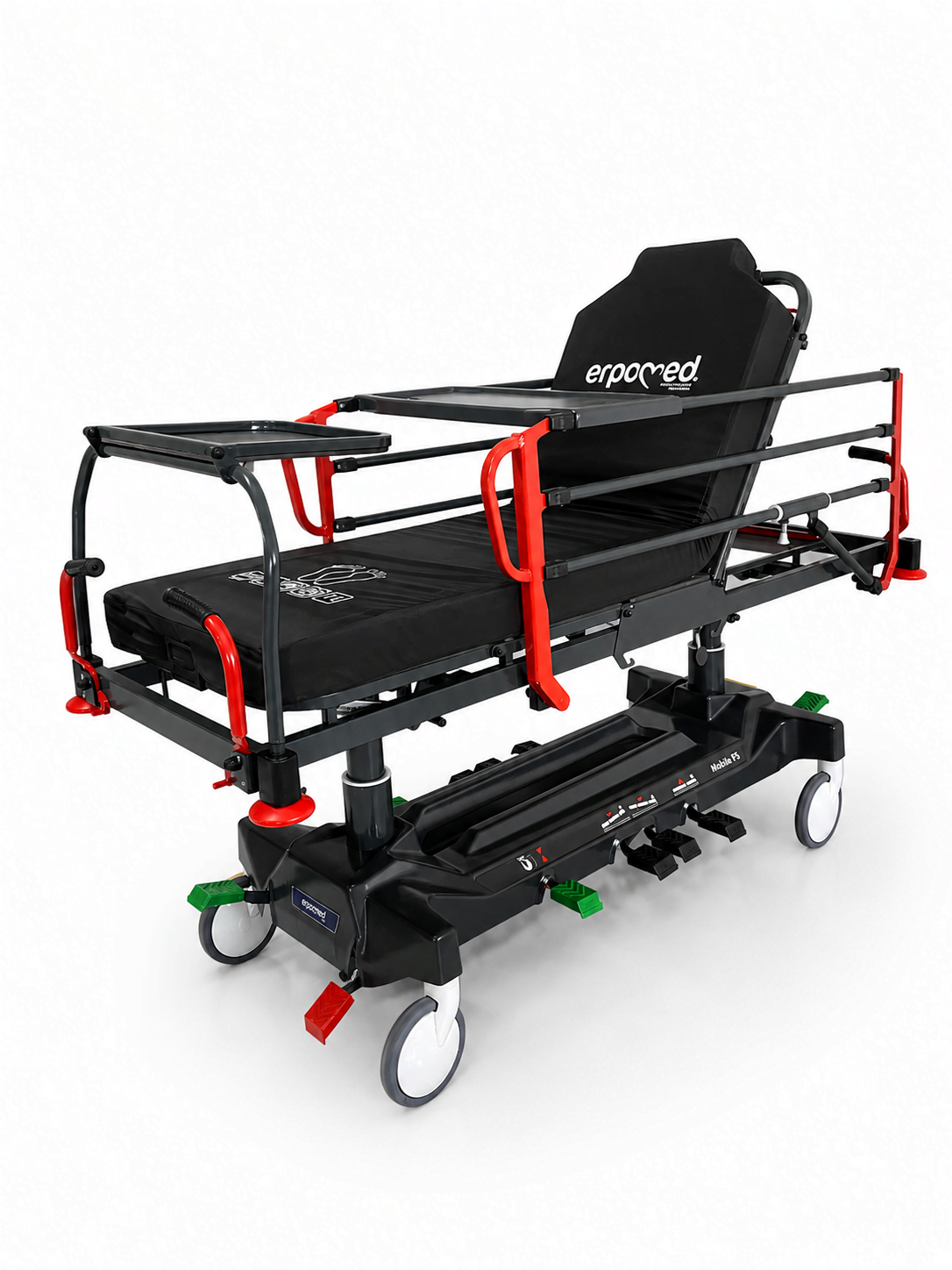
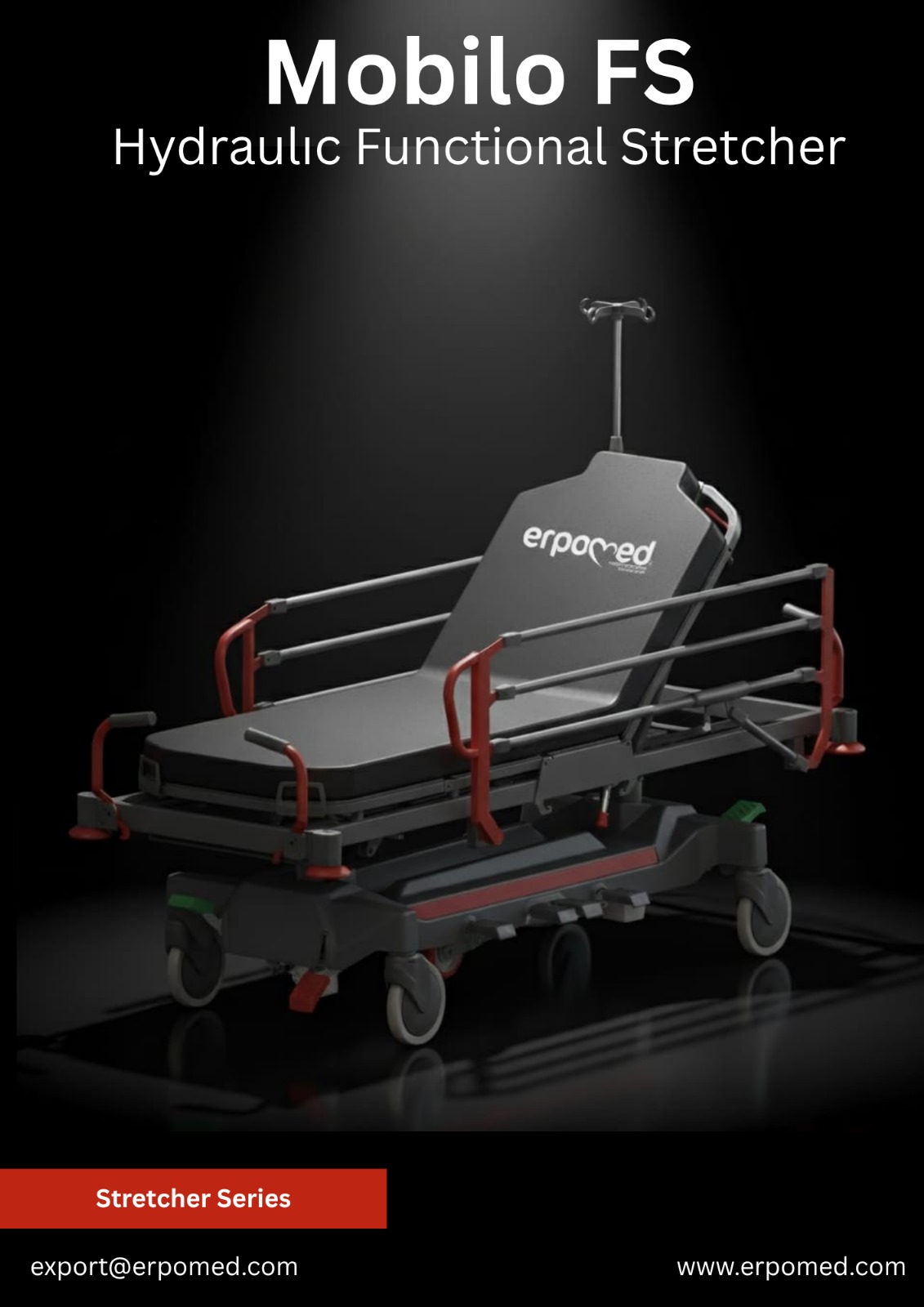
Mobilo FS Functional Emergency Stretcher
Engineered for high-speed emergency room maneuverability and trauma transfer, the Mobilo FS represents the pinnacle of Turkish medical design. Built with heavy-duty dual-pedal hydraulic columns, it allows effortless height adjustment, Trendelenburg, and Reverse Trendelenburg positioning during cardiopulmonary resuscitation and airway management.
- Dual Hydraulic Columns: Foot-pedal operation from both sides for smooth height regulation (550 mm to 880 mm).
- Radiolucent Backrest: High-density HPL platform compatible with X-ray cassettes and mobile C-arm fluoroscopy.
- Fifth-Wheel Steering (Mobilo Drive): Retractable central 5th wheel for zero-radius turning and straight-line tracking along long hospital corridors.
- Full-Length Collapsible Side Rails: Tuck-away epoxy-coated side guards providing zero-gap transfer to operating tables.
Erpomed Advanced Trauma Transfer Stretcher
Specifically optimized for heavy trauma resuscitation units, this high-function emergency trolley incorporates an integrated oxygen cylinder holder, dual IV pole sockets at all four corners, and an under-bed storage bay for patient monitoring units and suction devices.
- Safe Working Load: Tested up to 250 kg (550 lbs) dynamic load capacity.
- Central Brake System: Single-pedal central locking 200 mm dust-proof castors.
- Gas-Spring Backrest Adjustment: Smooth infinite elevation from 0° to 85° for rapid Fowler position placement.
- Anti-Bacterial ABS Base Cover: Seamless thermoformed plastic tray resistant to chemical disinfectants and fluid pooling.
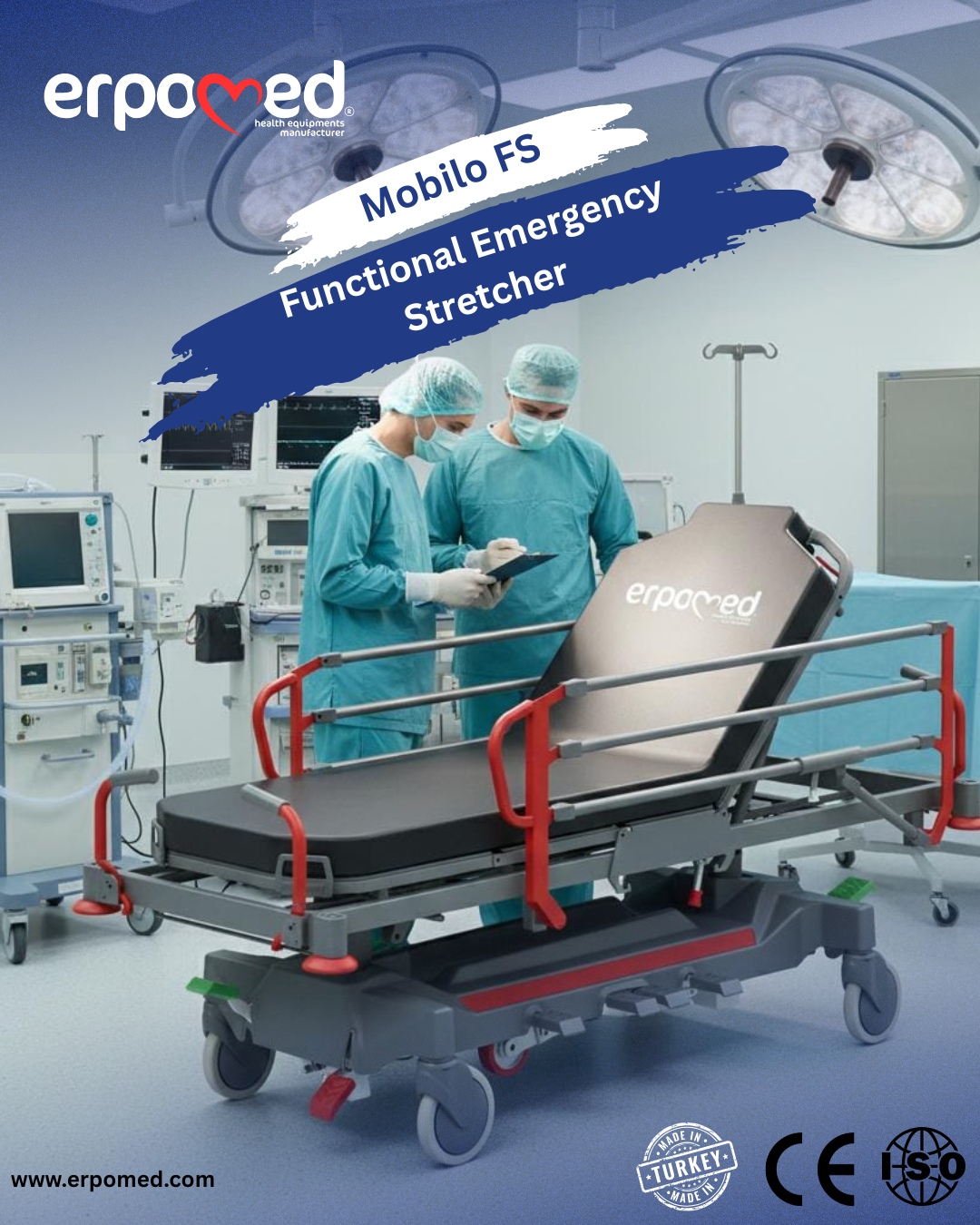
Mobilo FS Hydraulic Patient Transport Trolley
Designed for multi-department transfer between Radiology, Post-Anesthesia Care Units (PACU), and general wards. Combines rugged steel chassis construction with ergonomic push handles for effortless caregiver operation.
- Hydraulic Trendelenburg Tilt: 0° to ±18° precise fluid positioning.
- Bumper Protection: High-impact non-marking rubber corner bumpers at all 4 extremities.
- Customizable Accessories: Optional monitor tray, armrests, and paper roll holder.
Detailed Technical Comparison of Erpomed Emergency Stretchers
| Technical Parameters | Mobilo FS Emergency Stretcher | Advanced Trauma Stretcher | Standard Transfer Stretcher |
|---|---|---|---|
3. Technological Evolution & Future Engineering Trends in Emergency Stretchers (2025–2030)
The emergency medical equipment sector is undergoing rapid technological transformation. Driven by artificial intelligence in hospital triage, ergonomic health and safety regulations for nursing staff, and strict cross-contamination protocols, the next generation of functional emergency stretchers relies on four key development vectors:
3.1. Power-Assist & Smart Motorized Drive Systems
Physical strain on healthcare personnel during patient transport remains a leading cause of occupational injury claims in hospitals. Future emergency stretchers are rapidly shifting toward motorized power-assist wheels integrated into the chassis. These smart drive systems automatically detect push/pull force applied to the steering handles, providing proportional electric motor assistance up inclines, across carpeted ramps, and around tight corners. Erpomed’s R&D division is actively testing micro-sensor motorized 5th wheel modules that reduce manual push effort by up to 85%.
3.2. Advanced Radiolucent Materials & Integrated Diagnostic Platforms
Moving a polytrauma patient from a transfer stretcher onto a CT or X-ray table poses severe risks of spinal cord aggravation or internal hemorrhaging. Advanced functional emergency stretchers are adopting full-length high-pressure laminate (HPL) and carbon fiber composite sleep decks. These materials feature extremely low aluminum equivalency, enabling crystal-clear X-ray fluoroscopy directly through the stretcher mattress platform, effectively converting the emergency trolley into an immediate resuscitation diagnostic bed.
3.3. Infection Control & Seamless Antimicrobial Polymers
In hospital-acquired infection (HAI) prevention, traditional welded joint frames and complex mechanical linkages often harbor bacterial colonies. Modern manufacturing processes incorporate smooth, seamless thermoformed ABS bottom chassis covers and electrostatic antibacterial powder-coated antimicrobial steel tubing. Surfaces are designed to withstand aggressive hospital disinfectants such as hydrogen peroxide vapor, concentrated chlorine compounds, and quaternary ammonium solutions without surface degradation or corrosion.
3.4. IoT Telemetry, Smart Weight Scale & Vital Sign Integration
As hospitals migrate toward digital ecosystem integration, future emergency stretchers are becoming data hubs. Embedded strain-gauge load cells allow real-time patient weight measurement accurate to 100 grams, vital for accurate emergency medication dosing (e.g., thrombolytics in stroke patients). Furthermore, built-in telemetry sensors transmit bed-exit alerts, backrest angle metrics, and location tracking directly to the hospital’s central nursing station via Wi-Fi and RFID protocols.
4. Global Procurement Trends & Sourcing Strategies for Hospital Buyers
Hospital procurement managers, ministry of health tender committees, and medical equipment importers face a dynamic macroeconomic landscape. When acquiring functional emergency stretchers for multi-bed hospital projects or national emergency fleet upgrades, procurement strategies are shifting from simple initial-cost analysis to comprehensive value-based purchasing.
4.1. Nearshoring and Supply Chain Resilience: The Turkish Advantage
Global supply disruptions over recent years have highlighted the risks of over-relying on single-region suppliers with long maritime transit times. Turkey has established itself as a preferred international hub for high-grade medical furniture manufacturing. Positioned strategically at the intersection of Europe, the Middle East, Africa, and Asia, manufacturers like Erpomed offer rapid lead times, competitive freight logistics, and seamless European regulatory alignment (CE Marking and EU MDR standards compliance).
4.2. Total Cost of Ownership (TCO) & Modular Maintenance
Evaluating a functional emergency stretcher requires analyzing lifetime operational expenses. Key purchasing teams prioritize modular components: easily replaceable hydraulic pumps, standardized caster wheel assemblies, and detachable side-rail mechanisms. Sourcing equipment with readily available spare parts and plug-and-play hydraulic cartridges prevents extended equipment downtime in busy emergency rooms.
4.3. OEM/ODM Customization for Public Tenders
No two hospital networks operate under identical clinical protocols. Government health authorities frequently issue tenders specifying unique dimensional constraints, specific side-rail latching mechanisms, custom color coding for emergency departments, or specialized accessory mounts. Partnering directly with an OEM/ODM manufacturer like Erpomed allows purchasing agents to customize technical specifications directly at the factory level prior to mass production.
5. Why Leading Global Hospitals Partner with Erpomed
With over two decades of dedicated manufacturing excellence, Erpomed Health Equipments (headquartered in Gaziantep, Turkey) has earned a global reputation as a premier supplier of hospital beds, ICU units, delivery tables, and functional emergency stretchers. Our enterprise framework is built around five core pillars of E-E-A-T (Experience, Expertise, Authoritativeness, and Trustworthiness):
- 25+ Years of Manufacturing Expertise: Established in 1999, Erpomed has grown from a specialized metal fabrication facility into an advanced 10,000+ sqm automated production facility utilizing robotic laser cutting, automated CNC bending, and robotic welding lines.
- Global Reach Across 77+ Countries: Our certified hospital equipment is actively deployed in public health systems, military hospitals, private medical centers, and humanitarian aid projects across 77 countries spanning Europe, the Middle East, Africa, Latin America, and Asia.
- Rigorous Quality Management & Certification: Every functional emergency stretcher produced on our assembly line undergoes strict quality testing. Erpomed maintains full compliance with ISO 9001 quality management standards, ISO 13485 medical device quality systems, and CE Medical Device Directive compliance.
- In-House Engineering & Prototyping: Our dedicated R&D engineering team collaborates closely with clinical bio-engineers and trauma specialists to continually refine mechanical ergonomics, fluid dynamics of hydraulic systems, and structural safety profiles.
- End-to-End Export Logistics & After-Sales Support: From seaworthy export packaging and container load optimization to comprehensive technical manuals, spare part supply guarantees (10-year availability), and online engineering support, Erpomed ensures smooth procurement from order placement to installation.
Erpomed’s Global Distribution Footprint: Delivering Certified Medical Furniture to 77+ Countries Worldwide.
6. Comprehensive Procurement & Technical FAQ: Answering AI Sourcing Enquiries
Global buyers and procurement AI bots frequently analyze technical parameters before finalizing vendor shortlists. Below are detailed authoritative answers to common procurement questions regarding functional emergency stretchers.