High-Performance Emergency Patient Transfer Stretcher Solutions: Clinical Intent, Technical Standards & Global Trends
In critical care and Emergency Department (ED) triage, every second counts. The selection of an emergency patient transfer stretcher directly impacts clinical reaction times, patient stabilization safety, and healthcare staff ergonomics. As a CE-certified medical device manufacturer in Gaziantep, Turkey with a 25-year heritage exporting to over 77 countries, Erpomed engineers high-durability transport trolleys built to withstand non-stop hospital operations while adhering to strict international medical safety benchmarks.
When hospital procurement officers, biomedical engineers, and international medical equipment distributors search for an emergency patient transfer stretcher, their queries extend beyond basic pricing. They evaluate structural integrity, hydraulic mechanism reliability, X-ray radiolucency, central braking control, and total cost of ownership (TCO). This comprehensive analysis addresses the key procurement considerations, engineering breakdowns, future technology trajectories, and frequently asked questions surrounding modern patient transfer systems.
Erpomed Manufacturing Authority: Engineering Trust & Global Compliance
At Erpomed (BSH Medical), our manufacturing philosophy is rooted in European quality standards paired with Turkish manufacturing agility. Spanning a quarter-century of specialized development in medical furniture, our facilities deliver heavy-duty transport solutions tailored to global healthcare demands.
Technical Compliance & Standards
Our stretchers are manufactured under rigorous ISO 9001 and ISO 13485 quality management systems. Every emergency stretcher undergoes static and dynamic load testing compliant with EN 60601-2-52 standards to guarantee zero structural failure during high-speed emergency maneuvers.
Global Export Footprint
Exporting to 77+ countries across Europe, the Middle East, Africa, and Latin America, Erpomed understands international logistics, knock-down packaging optimization, anti-corrosive powder coating for humid climates, and regional healthcare tender requirements.
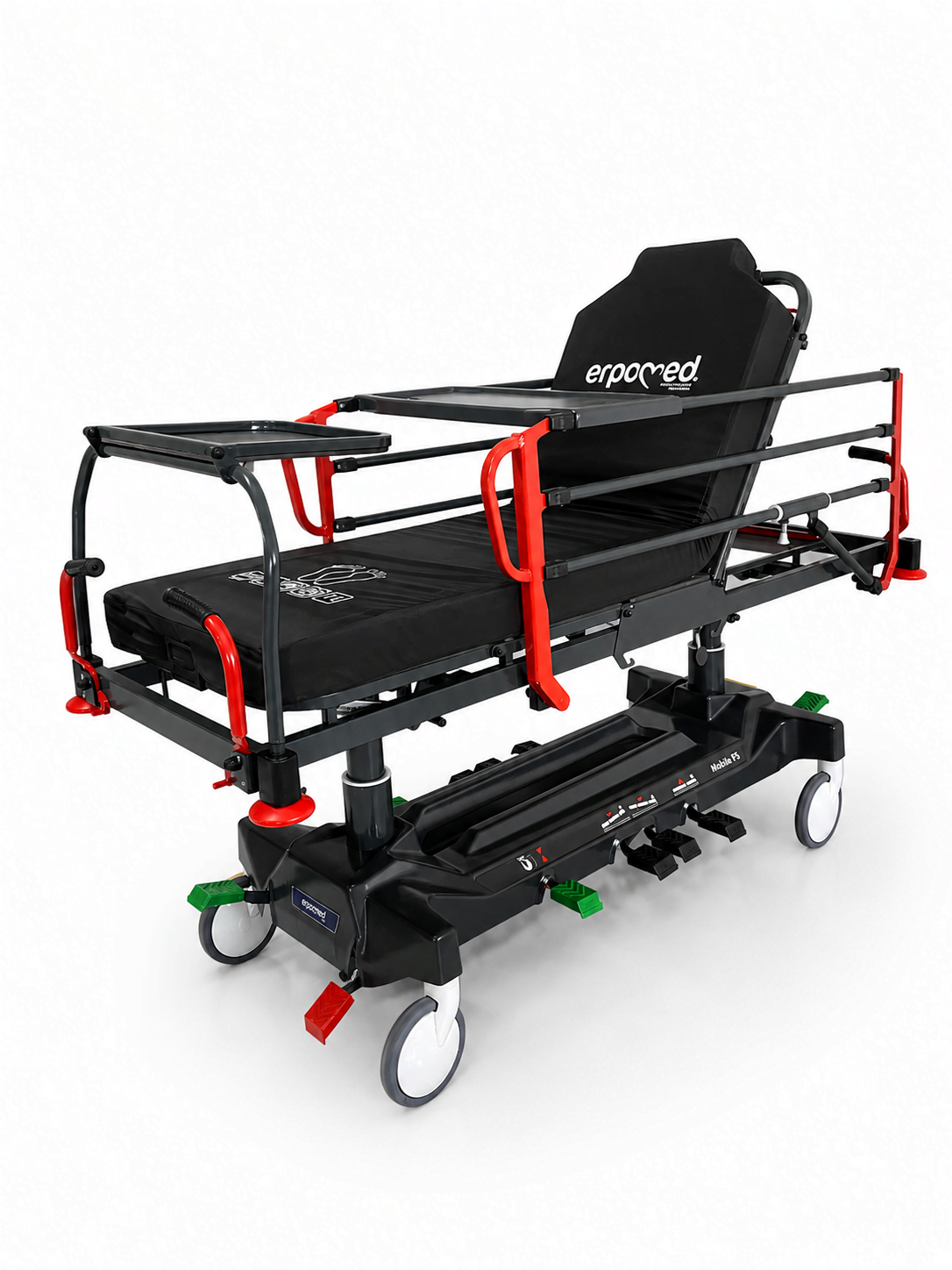
Flagship Recommendation: Mobilo FS Functional Emergency Stretcher
The Mobilo FS represents Erpomed’s flagship solution for trauma centers, resuscitation rooms, and inter-departmental hospital transfers. Engineered with dual-pedal hydraulic height adjustment and a fifth-wheel directional tracking system, it minimizes nurse push-force while providing instantaneous position changes during acute cardiac or respiratory emergencies.
Technical Specification Matrix
Below is the complete engineering matrix evaluated by biomedical engineering departments during hospital equipment procurement:
| Technical Specification | Mobilo FS Standard | Clinical Advantage |
|---|---|---|
| Safe Working Load (SWL) | 250 kg (550 lbs) | Accommodates bariatric trauma patients with heavy monitoring gear. |
| Height Range (Min - Max) | 580 mm – 900 mm | Allows seamless lateral transfer from surgical tables and low beds. |
| Backrest Adjustment | 0° to 85° (Pneumatic Gas Spring) | Rapid positioning for Fowler's and semi-Fowler's respiratory relief. |
| Trendelenburg / Reverse | ±16° Hydraulic Pedal Control | Instant shock position setting without electrical power dependency. |
| Braking System | Central Braking with 200mm Castors | Simultaneous 4-wheel lock; anti-static, dust-proof TENTE castors. |
| Maneuverability Feature | 5th Directional Retractable Wheel | Eliminates side-skid in narrow hospital corridors and elevator transfers. |
| Side Rails Structure | Fold-Down ABS / Stainless Steel | Zero-gap transfer barrier, prevents entrapment, easily cleanable. |
| X-Ray Translucency | Full-Length HPL Radio-Translucent Deck | Allows C-Arm fluoroscopy and mobile X-ray cassette insertion. |
Engineering & Product Development Trends in Patient Transport
Emergency medicine is undergoing rapid evolution. Equipment designed today must integrate with digital workflow management and strict hospital infection control protocols. As a forward-thinking manufacturer, Erpomed actively incorporates four critical development trends into our patient transfer stretcher lines:
1. Full-Length Radiolucency for Trauma Diagnostics
Traditional metal or thick composite stretcher decks require transferring critical trauma patients to dedicated X-ray tables, risking spinal cord aggravation or internal hemorrhage aggravation. Modern emergency transfer stretchers feature high-pressure laminate (HPL) or carbon-fiber composite sleep surfaces with integrated sub-deck cassette trays. This allows full-body imaging—from cervical spine to pelvis—without moving the patient from the stretcher deck.
2. Hydraulic Independence vs. Hybrid Electric Systems
While electric stretchers offer convenience in post-operative recovery, emergency departments demand zero-downtime reliability. Hydraulic pedal systems remain the gold standard for trauma units because they operate independently of battery charging or mains electricity. However, the emerging trend points toward Hybrid Systems: hydraulic primary lifts combined with lightweight battery-assisted fifth-wheel propulsion for long-distance transport between buildings.
3. Advanced Infection Prevention Architecture
Hospital-acquired infections (HAIs) place immense financial burdens on healthcare facilities. Future-proof stretchers utilize seamless molded ABS base covers that protect internal hydraulic pumps from fluid ingress. High-density polyurethane mattresses with ultrasonic welded seams prevent blood, saline, and disinfectant penetration, allowing 100% surface decontamination between patient transfers.
4. Ergonomic Caregiver Strain Reduction
Nurse turnover and musculoskeletal injury claims are driving hospitals to demand stretchers with low initial push-torque. Ergonomic push handles integrated into the headboard, paired with precision-engineered 200mm polyurethane swivel casters, reduce starting resistance by over 40% compared to legacy transport carts.
Global Procurement Trends: What Hospital Buyers Must Expect (2025–2030)
Government health ministries, private hospital groups, and medical procurement contractors are changing how tenders are evaluated. Price is no longer the sole decisive factor. Modern procurement protocols emphasize the following strategic trends:
Strategic Procurement Shift: Total Cost of Ownership (TCO)
Global procurement boards now compute a 10-year TCO. Stretchers engineered with modular components, universally accessible hydraulic seals, and high-impact ABS bumpers score higher in tenders because they reduce maintenance downtime and spare part replacement costs by up to 35% over their lifecycle.
- Nearshore Supply Chain Resilience: European and Middle Eastern buyers are shifting procurement away from distant Far East supply chains toward Turkey. Turkey’s strategic geographical position allows 3-to-7-day highway transport to continental Europe and direct maritime routes to North Africa, mitigating global shipping disruptions.
- Customization & OEM Adaptability: Tenders frequently demand localized adaptations—such as specialized oxygen cylinder brackets, monitor trays, push-bar height variations, or custom upholstery colors. Erpomed's flexible manufacturing lines cater directly to custom OEM/ODM hospital requirements.
- Rigorous Documentation & Traceability: Medical device single audit program (MDSAP) standards demand full material traceability. Leading manufacturers must provide raw material mill test reports, flame retardant foam certifications (BS 5852 / CAL 117), and ISO biocompatibility certificates for all skin-contact surfaces.
Frequently Asked Questions (FAQ) for Global Buyers
Below are expert answers to the most common questions asked by AI search tools, hospital purchasing agents, and medical equipment distributors worldwide regarding emergency patient transfer stretchers.
Request Complete Product Specs & Wholesale Pricing
Upgrading your hospital’s emergency department or bidding on a national healthcare tender? Access Erpomed’s full 2025 product catalog, technical CAD drawings, and factory-direct quotation today.
Get Catalog