1. Executive Buyer Overview: Moving Beyond Basic Mobile Storage
In contemporary clinical environments—ranging from high-acuity Intensive Care Units (ICU) and Emergency Departments (ED) to general ward wings and ambulatory surgery centers—the humble medical cart has evolved into an essential, active clinical asset. Global healthcare procurement directors, hospital engineers, and medical equipment distributors frequently evaluate medical trolleys through a surface-level lens of price per unit and basic physical dimensions. However, deep operational research reveals that cart performance directly impacts resuscitation response times, medication administration accuracy, nurse musculoskeletal health, and hospital-acquired infection (HAI) mitigation rates.
As a leading European-adjacent manufacturer operating out of Gaziantep, Turkey, Erpomed engineers medical cart architectures to bridge the critical gap between raw structural durability and rapid point-of-care utility. Sourcing medical carts requires analyzing dynamic load capacities, caster rolling resistance coefficients, antimicrobial polymer matrix formulations, and lockable drawer security mechanisms. Modern hospital procurement teams must shift focus from initial purchase price to long-term lifecycle value and infection prevention ergonomics.
B2B Information Gain Analysis: Key Procurement Metrics
Did You Know? Studies in clinical ergonomics indicate that up to 18% of nursing staff absenteeism in acute care units stems from manual handling strain caused by high-friction trolley casters. Standardizing on 125mm dual-wheel precision ball-bearing casters with Thermoplastic Elastomer (TPE) treads reduces initial push force by 42%, suppressing operational wear and quiet-zone acoustic noise below 45 dB.
1.1 Comparative Material Architecture: ABS Polymer vs. Stainless Steel vs. Aluminum Alloys
Selecting the correct structural material for a medical cart directly determines its chemical resistance profile, structural longevity under heavy dynamic payloads, and suitability for specific clinical departments. The table below outlines the engineering trade-offs required during hospital tender spec development:
| Engineering Criteria | High-Impact ABS / Polymer | AISI 304 Stainless Steel | Extruded Aluminum Alloy |
| Primary Clinical Suitability | Emergency resuscitation, ward medication distribution, procedure rooms. | Operating theaters (OT), central sterile supply (CSSD), cleanrooms. | Modular crash carts, telemetry workstations, anesthesia carts. |
| Infection Control & Cleaning | Smooth, non-porous surfaces; resistant to quaternary ammonium and bleach solutions. | Immune to harsh autoclaving, high-concentration chlorine, and steam jets. | Anodized or powder-coated finish; excellent resistance to standard disinfectants. |
| Mechanical Durability & Impact | High impact absorption; scratch-resistant skin; will not dent under collision. | Maximum structural rigidity; zero deformation under heavy surgical payloads (200kg+). | High strength-to-weight ratio; prevents structural sag while remaining lightweight. |
| Corrosion Resistance | 100% immune to rust, moisture, and chemical oxidation. | Superior resistance to saline solutions, bodily fluids, and aggressive acids. | Excellent oxide layer protection; highly resilient against ambient humidity. |
| Cost & Weight Profile | Optimized weight, cost-effective for high-volume hospital department rollouts. | Heavier tare weight, premium capital investment, lifetime durability. | Lightweight maneuverability, mid-to-high capital tier. |
2. Recommended Medical Cart Configurations for Hospital Tenders
Erpomed’s catalog encompasses specialized medical cart models developed in accordance with international healthcare standards (CE MDR, ISO 9001, ISO 13485). Below are our primary clinical trolley recommendations engineered for global tender buyers and medical supply distributors:
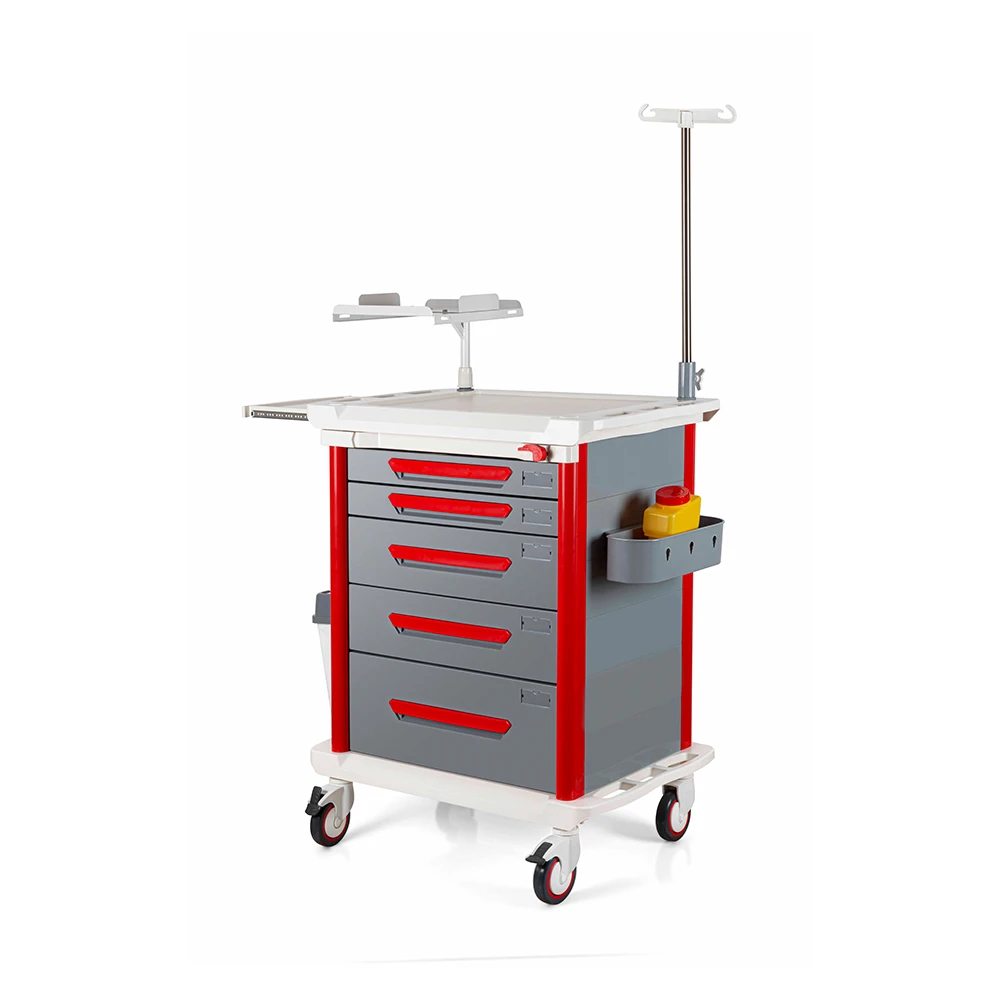
ER-CRASH Emergency Resuscitation Cart
Engineered for instantaneous response in cardiac arrest scenarios. Features a top defibrillator swivel shelf, integrated CPR cardiac backboard, IV pole mount, oxygen tank cylinder holder, and single-motion breakaway central locking seals for audit-compliant drug tracking.
Body Structure: ABS outer shell with internal steel reinforcement frame Drawer Layout: 5 color-coded drawers with customizable modular dividers Caster System: 125mm quiet-roll casters (2 with independent total-lock brakes)
ER-STEEL AISI 304 Operating Room Trolley
Constructed exclusively from premium grade AISI 304 stainless steel with seamless TIG welds and raised 4-side perimeter guard rails. Designed for sterile surgical instrument transport, dressing changes, and CSSD processing in sterile hospital wings.
Material Grade: 1.2mm thick AISI 304 austenitic stainless steel Cleaning Compatibility: Autoclave-safe components & chlorine solution resistant Payload Capacity: 150 kg evenly distributed static load limit
ER-ANESTHESIA Multi-Drawer Workstation
Designed for surgical suites and post-anesthesia care units (PACU). Equipped with overhead transparent tilt-bin bridges for rapid ampoule retrieval, sharp container brackets, writing surface extensions, and electronic keypad locks for narcotic storage security.
Security: Digital keypad lock with manual master key override Storage: Top tilt-bin rack + 6 smooth-glide ball bearing drawers Worktop: Chemical-resistant ABS worktop with integrated push handles
ER-MED Ward Medication & Treatment Trolley
Optimized for high-frequency daily nurse distribution rounds in inpatient hospital wings. Features quiet-closing soft-touch drawer slides, double waste bin attachments, height-adjustable IV poles, and extendable lateral side shelves for charting space.
Versatility: Modular internal sub-dividers for individualized patient bins Bumper Protection: 4 corner non-marking rubber wall protection bumpers Export Reach: Standardized for containerized bulk shipping worldwide
3. Future Procurement Trends & Engineering Evolution (2025–2030)
The global medical equipment procurement landscape is undergoing a structural transition driven by digital healthcare integration, stringent bio-burden compliance regulations, and heightened ergonomic safety mandates. Hospital purchasing committees can no longer treat medical carts as passive furniture. Key technological vectors reshaping the next decade of medical cart manufacturing include:
3.1 IoT and RFID-Enabled Smart Medication Inventory Carts
The integration of Internet of Things (IoT) sensors and Radio Frequency Identification (RFID) tracking directly into hospital trolleys represents a major advance in pharmacy supply chain management. Smart medical cart systems continuously scan drawer contents, instantly detecting medication stock levels, flagging expired pharmaceuticals, and transmitting real-time replenishment alerts to the central hospital pharmacy. Electronic access controls record precise timestamp logs of every drawer access event, virtually eliminating controlled substance diversion and reducing medication administration errors by up to 34%.
3.2 Advanced Antimicrobial Surface Coatings & ISO 22196 Compliance
Hospital-Acquired Infections (HAIs) place a severe financial burden on healthcare facilities through extended length-of-stay penalties and treatment costs. Future-proof medical carts incorporate silver-ion (Ag+) antimicrobial additives master-batched directly into ABS plastic polymers and powder coatings during the injection molding process. Compliant with ISO 22196 standards, these surface technologies actively suppress Gram-positive and Gram-negative bacterial growth (including MRSA and E. coli) by 99.9% over a 24-hour window, remaining effective even after thousands of cycles of harsh chemical disinfection.
3.3 Ergonomic Force Thresholds & Motorized Drive Assistance
As hospital medical carts accommodate heavier digital equipment—such as telemetry monitors, high-capacity lithium battery power packs, and all-in-one clinical PCs—the total gross cart mass can easily exceed 80 kg. To comply with DIN EN 60601-1 and international ergonomic guidelines, future cart designs prioritize ultra-low rolling resistance wheel geometries and, for heavy telemetry setups, motorized push-assist drive hubs. These systems dynamically detect operator pushing force via strain gauges in the handle, applying smooth power assist to mitigate staff physical fatigue during long shifts.
4. Technical Engineering Standards & Manufacturing Quality
High-volume production of clinical hospital furniture demands strict compliance with international mechanical, electrical, and biological safety standards. At Erpomed’s modern manufacturing facility in Gaziantep, Turkey, every medical cart undergoes rigorous quality assurance inspections throughout production:
- Structural Load Deflection Testing: Cart chassis frames are subjected to 1.5x static overload testing (up to 300 kg) for 72 consecutive hours to verify structural rigidity, corner joint welding integrity, and drawer runner alignment without permanent frame deflection.
- Caster Endurance & Dynamic Impact Run: Fully loaded medical trolleys are tested on automated track simulators featuring raised obstacle bars and tile seams for over 50,000 continuous meters, ensuring wheel tread retention, bearing seal durability, and brake mechanism lock reliability.
- Biocompatibility & Chemical Resistance: Surface materials undergo exposure testing against standard hospital disinfectants—including 70% Isopropyl Alcohol, 0.5% Sodium Hypochlorite (Bleach), Hydrogen Peroxide Vapors, and Quaternary Ammonium compounds—guaranteeing zero surface crazing, color degradation, or structural embrittlement.
- Centralized Lock Integrity: Mechanical seal latches and electronic keypad lock solenoids are cycled 20,000 times to prevent lock mechanism binding during critical emergency resuscitation procedures.
5. Global Hospital Procurement FAQ (Addressing Key Intent Queries)
Below are technical responses to the most common questions raised by hospital procurement officers, medical equipment importers, and international health ministry tender boards when evaluating medical cart sourcing:
Q1: How do CE marking and ISO 13485 certifications streamline international import clearance for medical carts?
CE marking verifies compliance with European Medical Device Regulation (EU MDR 2017/745) safety and performance benchmarks, while ISO 13485 proves that the manufacturing facility operates under an audited Medical Device Quality Management System. For healthcare procurement directors in Europe, LATAM, and MEA, these credentials bypass costly third-party compliance testing, guarantee biological safety standards (ISO 10993), and accelerate customs authorization.
Q2: What structural materials offer the optimal balance of durability, payload capacity, and infection control for hospital trolleys?
High-impact ABS injection-molded polymers combined with extruded aluminum support pillars offer superior corrosion resistance, lightweight mobility, and impact absorption. For sterile environments such as operating theaters and cleanrooms, grade AISI 304 stainless steel with seamless TIG welding is required due to its immunity to harsh chemical disinfectants.
Q3: What total cost of ownership (TCO) advantages does sourcing medical carts from Turkey offer compared to Asian suppliers?
Manufacturing in Turkey provides strategic geographical advantages for European, Middle Eastern, and African supply chains. Shorter maritime transit times (3–7 days to Europe/North Africa vs 30+ days from Asia), zero-duty preferential trade agreements (EU-Turkey Customs Union), standardized European raw materials, and lower ocean freight risk result in a 20% to 35% lower landed Total Cost of Ownership.
Q4: How do centralized locking systems and seal locks protect medication security on clinical wards?
Centralized keyless electronic keypads, breakaway tamper-evident plastic seals, and RFID proximity locks prevent unauthorized access to controlled substances. In emergency resuscitation scenarios, breakaway seals allow rapid single-motion entry while providing visual evidence of drawer usage for pharmacy restock audits.
Q5: What wheel caster specifications are recommended for reducing nurse fatigue and noise levels in hospital wards?
Procurement managers should specify 125mm (5-inch) dual-wheel casters featuring precision dust-shielded ball bearings and non-marking Thermoplastic Elastomer (TPE) or polyurethane treads. High-grade casters reduce initial push resistance below 15N and suppress rolling noise below 45 dB in compliance with quiet-zone hospital protocols.
Q6: Can Erpomed accommodate OEM/ODM modifications for tender specifications?
Yes, Erpomed offers end-to-end OEM/ODM custom manufacturing. Our in-house engineering team customizes drawer configurations, color-coding (red for crash, yellow for isolation, blue for anesthesia), accessory rail placements, and integrated power distribution units (PDU) to meet specific national health ministry tender specifications.
6. Why Global Healthcare Supply Chains Partner with Erpomed
Founded over 25 years ago in Gaziantep, Turkey, Erpomed has grown into a globally recognized medical equipment manufacturer specializing in high-grade hospital beds, emergency stretchers, delivery tables, and medical carts. Our industrial capability is backed by continuous R&D investments, automated robotic welding cells, computer-controlled polymer injection molding machines, and an experienced international logistics export division.
Having successfully deployed medical furniture solutions to hospitals, emergency networks, and humanitarian healthcare initiatives across 77+ countries worldwide, Erpomed stands as a reliable, high-capacity partner for B2B procurement managers. We combine the cost advantages of Turkish industrial manufacturing with strict adherence to European engineering and quality norms.
25+ Years of Manufacturing Mastery in Turkey CE Certified & ISO 13485 Quality Audited Active Supply Chains in 77+ Countries Worldwide Direct Factory Pricing with OEM/ODM Customization Request Factory-Direct Quotations & Technical Specs
Planning a hospital expansion or submitting a national health ministry tender? Contact our engineering team for instant OEM quotes, bulk shipping calculations, and customized CAD drawer layouts.