
Why Choose an Emergency Patient Transfer Stretcher?
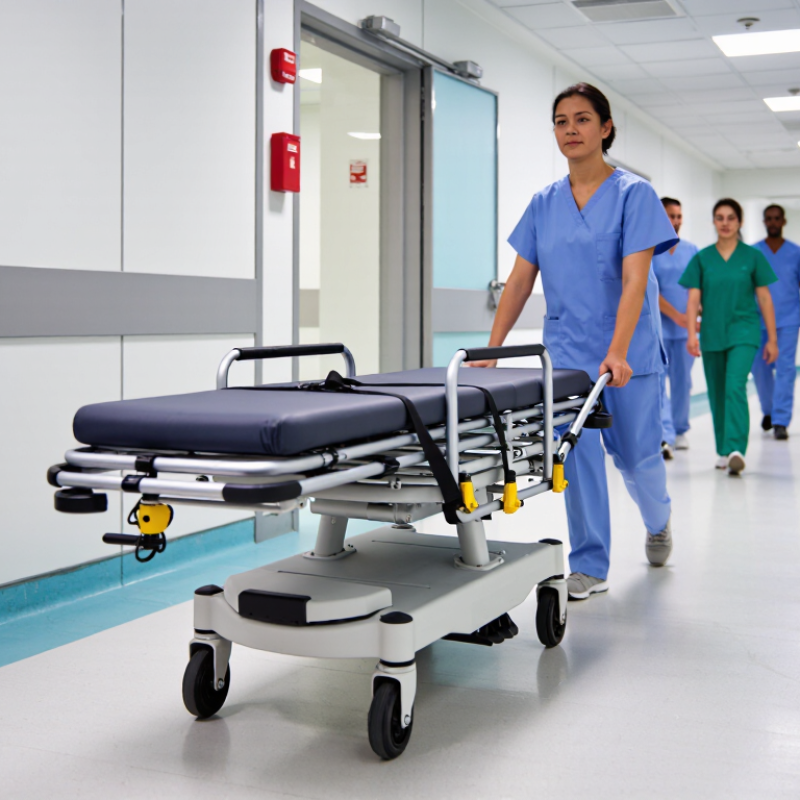
An emergency patient transfer stretcher supports safer, faster movement when every second matters. Its value appears beside crowded ambulance bays, narrow corridors, and brightly lit trauma rooms. Adjustable height, locking casters, side rails, and secure restraint systems can reduce instability during transfers. A powered model may also limit pushing, pulling, and lifting by clinical teams.
The World Health Organization’s Global Patient Safety Report 2024 estimates that one in ten patients experiences harm during healthcare. More than half of this harm is considered preventable. WHO also emphasizes safer systems, reliable processes, and effective communication. NIOSH guidance identifies patient handling as a serious source of musculoskeletal strain for healthcare workers. These findings support equipment choices based on workflow, patient condition, and staff capability.
Audrey Nelson, PhD, a recognized safe patient-handling researcher, states, “The goal is to eliminate manual lifting.” An emergency patient transfer stretcher helps move that principle into daily practice. Smooth steering matters when an oxygen line crosses the floor. A low deck matters when a weak patient needs lateral movement. Clear controls matter during noise and confusion.
Still, no stretcher solves every transfer.
Hospitals must inspect brakes, wheels, rails, batteries, and mattress surfaces regularly. Staff need practical training, not only a short demonstration. Selection should consider bariatric capacity, infection-control requirements, elevator dimensions, and emergency power availability. The evidence is persuasive, but equipment alone is insufficient. A well-designed emergency patient transfer stretcher becomes most effective within a tested, monitored, and continually improved patient-transfer program.
Definition and Purpose of an Emergency Patient Transfer Stretcher
Why Choose an Emergency Patient Transfer Stretcher?
An emergency patient transfer stretcher is a wheeled medical platform for moving patients safely. It supports transfers between ambulances, emergency rooms, imaging areas, and operating departments. Its purpose is clear: reduce unnecessary lifting, turning, and physical strain during urgent care. But simplicity can mislead.
In practice, adjustable height, side rails, lockable casters, and safety belts help maintain patient stability. A firm mattress supports the body during movement and may reduce discomfort. A lower position improves stability during loading. A raised position gives clinicians better access for assessment and treatment. Oxygen cylinders, monitors, and intravenous lines also need organized space. Small details matter.
Experienced clinical teams inspect the frame, wheels, brakes, and locking systems before use. They also confirm the stretcher’s weight capacity and fit within elevators or narrow corridors. A transfer stretcher cannot replace clinical judgment or an appropriate handling protocol. Patients with spinal concerns, severe pain, or unstable vital signs may require specialized support. The uncomfortable truth is that equipment can still be misused when communication is rushed. A missed brake check or loose side rail may create avoidable risk. Careful teamwork remains essential, even when every second matters.
Why Choose an Emergency Patient Transfer Stretcher? - Definition and Purpose of an Emergency Patient Transfer Stretcher
| Data Dimension | Definition or Typical Specification | Emergency-Use Purpose | Practical Benefit |
|---|---|---|---|
| Product definition | A wheeled medical device designed to support, move, position, and monitor a patient during emergency care and internal transport. | Transfers patients between an ambulance, emergency department, diagnostic area, operating room, intensive care unit, or inpatient room. | Reduces the need to lift or manually carry patients during time-sensitive transfers. |
| Primary patient position | Usually supports supine, semi-Fowler, Fowler, and sometimes lateral positioning, depending on the model and clinical protocol. | Allows clinicians to select a position appropriate for airway management, breathing difficulty, shock assessment, examination, or transport. | Improves access to the patient while helping maintain alignment and stability. |
| Height adjustment | Many emergency stretchers provide adjustable working heights; the exact range varies by design, commonly covering low transfer height to a higher treatment position. | Supports safer lateral transfers, examination, resuscitation, and access for staff of different heights. | Can reduce awkward bending and improve caregiver ergonomics when used correctly. |
| Backrest adjustment | A multi-position backrest enables the upper body to be raised from flat to a seated or semi-seated posture. | Helps accommodate respiratory distress, aspiration precautions, neurological assessment, and patient comfort where clinically appropriate. | Provides rapid positioning without moving the patient to another surface. |
| Maximum safe working load | The permitted total load includes the patient, mattress, accessories, and equipment. Common rated capacities are approximately 200–320 kg, but the manufacturer’s stated limit must be followed. | Provides an appropriate support surface for patients across a broad range of body sizes during urgent care. | Helps staff select equipment safely and avoid overload-related instability or mechanical failure. |
| Patient restraint | Safety straps and side rails are used to help limit falls and unintended movement; they do not replace clinical observation. | Protects the patient during movement, cornering, height adjustment, and changes in backrest position. | Improves transport security when restraints are correctly fitted and monitored. |
| Wheel and steering system | Typically includes four swivel casters, central or individual brakes, and directional steering features; wheel sizes and configurations vary. | Supports controlled movement through corridors, treatment areas, ramps, and ambulance loading zones. | Improves maneuverability and helps keep the stretcher stationary during care. |
| Emergency treatment access | The mattress platform is generally designed to permit access to the chest and abdomen, with compatible space for essential emergency equipment. | Allows clinicians to perform assessment, oxygen therapy, defibrillation, airway care, and other interventions according to training and protocol. | Minimizes unnecessary patient transfers during initial stabilization. |
| Equipment storage | Common storage options include an under-frame shelf, oxygen-cylinder holder, accessory rails, IV-pole attachment, and monitor or infusion-pump supports, depending on configuration. | Keeps frequently needed equipment available during transport without placing loose items on the patient surface. | Improves organization and may reduce delays when equipment is compatible and secured. |
| Radiographic compatibility | Some models are designed with radiolucent sections or imaging clearance to support selected X-ray examinations without moving the patient. | Can facilitate imaging for trauma or critically ill patients when the stretcher’s approved configuration is suitable. | May reduce handling, pain, and risk associated with an additional transfer. |
| Surface and infection control | Mattress covers and frame surfaces are commonly designed to be smooth, durable, and cleanable with healthcare-approved disinfectants. | Supports cleaning and disinfection between patients, subject to facility policy and product instructions. | Helps maintain a safer care environment and limits contamination from high-touch surfaces. |
| Best-use scenarios | Emergency department intake, trauma evaluation, ambulance-to-hospital transfer, urgent diagnostic movement, and short-term monitored transport. | Provides a continuous, mobile support surface for patients who may require rapid reassessment or intervention. | Combines mobility, positioning, safety, and treatment access in one device. |
| Selection priorities | Evaluate safe working load, overall dimensions, braking, height range, mattress design, accessory compatibility, cleaning requirements, power or hydraulic operation, and local safety regulations. | Ensures the stretcher matches patient needs, facility layout, staffing, transport routes, and emergency procedures. | Supports safer workflow, easier maintenance, and more consistent emergency response. |
Note: Specifications such as load capacity, dimensions, height range, imaging clearance, and accessory compatibility vary by stretcher design. Always verify the device label, instructions for use, and applicable healthcare-facility procedures before operation.
FAQS
It is a wheeled platform for moving patients between ambulances, treatment rooms, imaging areas, and operating departments. It reduces unnecessary lifting and turning. It does not replace clinical judgment.
Useful features include adjustable height, lockable casters, side rails, safety straps, and a firm mattress. Wide wheels improve stability on crowded floors. Small details matter.
Staff can align the stretcher with a hospital bed or ambulance platform. This may reduce lifting strain during transfers. A lower position can improve stability during loading.
Side rails should lock securely and remain easy to operate with gloved hands. Safety straps can help maintain positioning during turns, ramps, and sudden stops. They must be applied carefully, not automatically.
Staff should inspect the frame, wheels, brakes, side rails, straps, and locking systems. They should confirm the weight capacity and route clearance. A missed brake check can create avoidable risk.
Staff should check elevators, doorways, ramps, and corridors before movement. Remove clutter and assign clear hand positions. Rushed communication remains a weakness.
No. Patients with spinal concerns, severe pain, or unstable vital signs may need specialized support. The stretcher must match the patient’s condition and the handling procedure.
A firm, padded surface may reduce discomfort during movement. Smooth surfaces support more consistent cleaning between patients. Comfort is not guaranteed.
No. Training, pre-use checks, and clear communication remain essential. Loose rails, crowded corridors, or sudden stops can still create danger. Practice must improve.
Conclusion
An emergency patient transfer stretcher is a specialized mobile platform designed to move patients safely and efficiently during urgent care, transport, examination, or treatment. It supports patients who may be injured, weak, immobile, or medically unstable, while reducing unnecessary movement and physical strain on caregivers. Key features may include a strong frame, adjustable height, secure side rails, patient restraints, smooth-rolling casters, protective padding, and compatibility with essential medical equipment.
Emergency patient transfer stretchers are valuable in hospitals, emergency departments, ambulances, clinics, and disaster-response settings. They help improve patient comfort, reduce the risk of falls or handling injuries, and support faster workflow for medical teams. When choosing the right stretcher, facilities should consider weight capacity, dimensions, maneuverability, braking performance, ease of cleaning, patient positioning options, durability, storage needs, and staff training requirements. The best choice should match the facility’s environment and the specific needs of both patients and caregivers.